Marriott & CitizenM - The Brand that sets the Standard
In 2005, Rattan Chadha sold Mexx, the Dutch fashion brand he had built into a global retailer, and turned his attention to a problem he had watched his designers suffer through for a decade. They traveled constantly and could never find a hotel that matched who they were. Luxury properties were priced for expense accounts they didn't have. Budget properties were tolerably cheap and intolerably grim. The middle market offered neither quality nor character. He decided to build a hotel for them.
Two Roads to the Same Building
The Marriott story and the CitizenM story are usually told separately. One is a legacy hospitality company that discovered modular construction late. The other is a design-led startup that industrialized from day one. Read together, they make a single argument: when a buyer holds a product specification tightly enough, long enough, and at sufficient scale, the supply chain eventually industrializes around it. The buyer doesn't need a manufacturing strategy. They need product discipline. The manufacturing follows.
Marriott arrived at industrialization through brand protection. CitizenM arrived through product design. In 2025, Marriott acquired CitizenM for $355 million—buying the company that had solved the problem Marriott had been working on since 2014. The acquisition is the thesis in a transaction.
Marriott: The Flag as Specification Enforcement
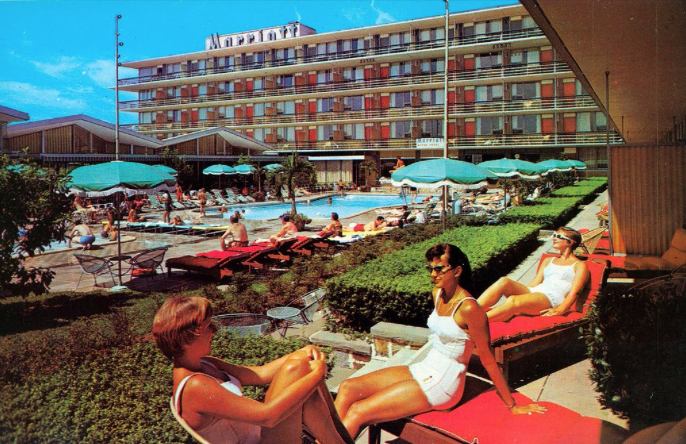
Marriott Twin Bridges property in 1957 - Marriott’s early entry into the upscale motor lodge segment included a swimming pool and many recreational amenities.
Marriott launched Courtyard by Marriott for business travelers and Fairfield Inn for budget-conscious families in 1983 and 1987, respectively. Both were built on standardized architectural footprints with moderate rooms, affordable pricing, and comfort over amenities, and could be replicated across a franchise system. This franchisee wanted to fly the Marriott flag built to Marriott's specs. Vary from the spec, and you lose the flag. The flag was worth enough in terms of the reservation system, the loyalty program traffic, and the credibility that national branding confers for franchisees to accept the constraint.
Across hundreds of properties annually, the brand’s constraint aggregated thousands of individual developer decisions into what, from the supply chain's perspective, appeared to be a single, repeatable buyer. Architects who worked repeatedly on Marriott-flagged properties developed efficient workflows. Contractors who built multiple Courtyards learned the building. The learning curve ran quietly through the franchise system without anyone naming it as industrialization.
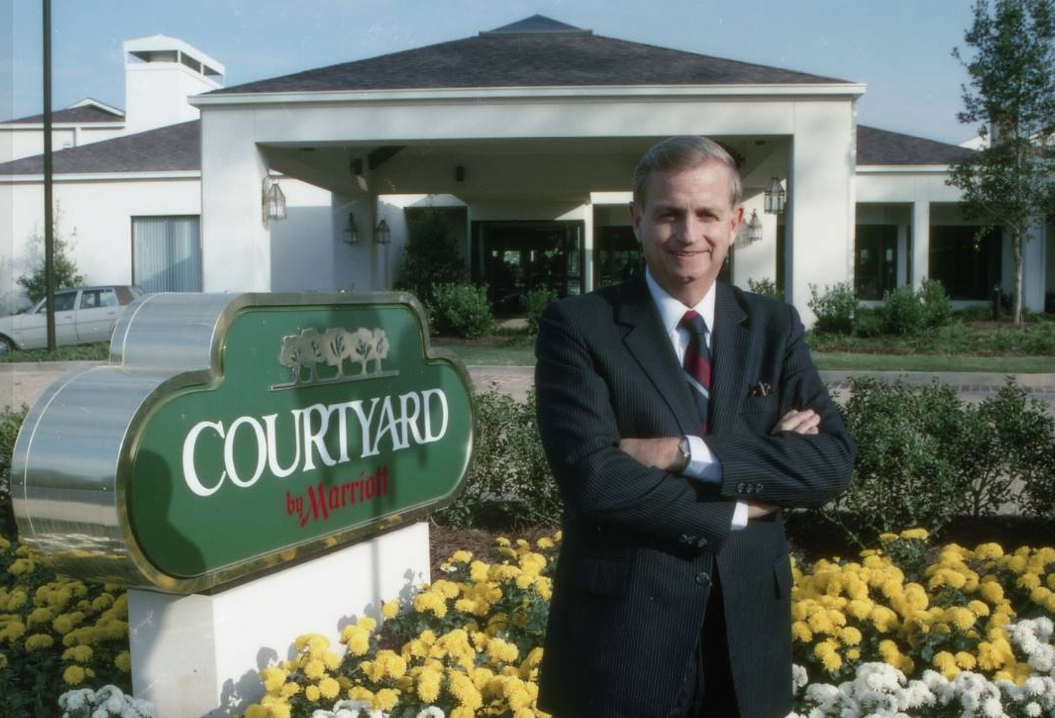
Bill Marriott in front of an early Courtyard Marriott in Atlanta, Georgia.
Then the labor market tightened, and the efficiency the system had been quietly accumulating became visible: when construction times lengthened, and costs rose, the franchise system had no production response. Since 2011, Marriott has seen the average time to build and open a hotel in North America increase by up to 50%. Costs have also continued to rise. In 2017, Eric Jacobs, Marriott's Chief Development Officer for Select Service Brands, described the pressure directly: "As construction costs are at a peak, it's a real challenge to find good, qualified subcontractors."
Marriott began researching modular construction in 2014. By 2015, it had launched a pilot initiative incorporating prefabricated guestrooms and bathrooms across Fairfield, Courtyard, SpringHill Suites, TownePlace, and Four Points. Standardizing the guest room into a common rectangular element - door on one side, window on the other, bathroom and closet, followed by bed and desk in a simple living area - allowed supply chain partners to choose industrial applications. In 2016, Guerdon, an Idaho-based manufacturer, documented the first Fairfield Inn and Suites in Folsom, California, to be built using fully modular construction. Completing the project from groundbreaking to opening in less than 9 months. Guerdon also started module construction and delivery for two additional Marriott projects. The manufacturing line was running, and the potential for industrialization was clear. Across the fleet, Marriott estimated that modular construction shaved three to eight months off select-service timelines compared with a conventional twelve to fourteen-month build.
In 2019, Marriott announced the AC Hotel New York NoMad. planned as the world's tallest modular hotel at 360 feet and scheduled to stack in just 90 days. Then Marriott ran into the ceiling that every demand-side actor eventually hits when supply hasn't industrialized to match. Jennifer Abuzeid, Marriott's Senior Director of Global Design Strategies, acknowledged the constraint plainly: finding enough module manufacturers to meet the company's needs remained a battle. With no capable regional manufacturer available, modules would have to be shipped from a facility in Poland, stretching the supply chain across an ocean to serve a Manhattan construction site. The demand signal was clear. The supply chain hadn't yet organized around it. Marriott ultimately abandoned NoMad in 2024, selling the site to another developer.
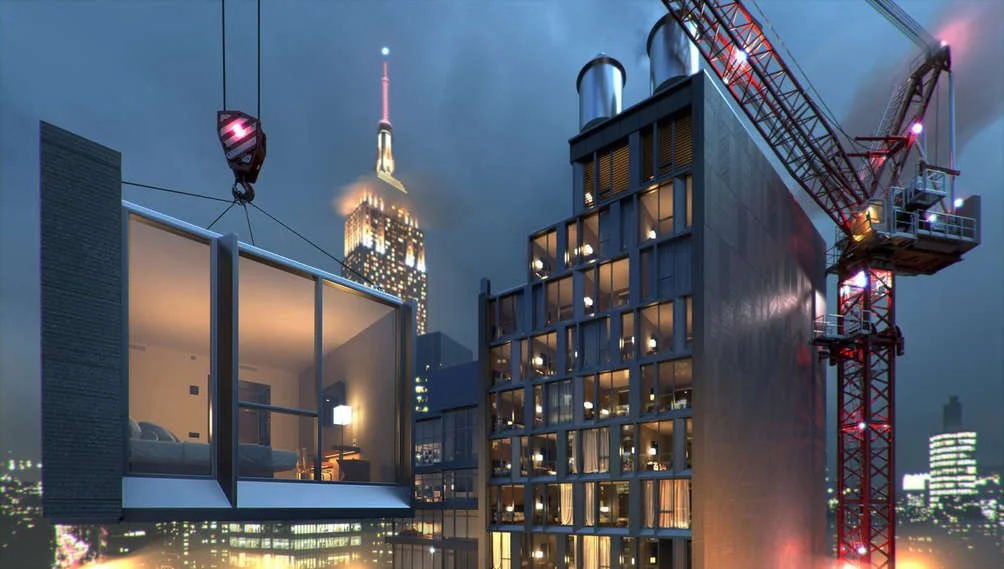
Rendering of AC Hotel New York NoMad modules being lifted, 2019. The project was subsequently abandoned in 2024 due to the economics of the build. (Source: Danny Foster Architects)
CitizenM: The Module as Manufacturing Brief
While Marriott was retrofitting manufacturing logic onto a franchise system built for site construction, Chadha's design team at CitizenM proposed a solution that embedded manufacturing logic into the product from the start: a guest room module the size of a standard shipping container.
At 14 square meters, the module contained everything a traveler needed and nothing they didn't. A king bed. A powerful shower. A high-resolution television. A programmable climate system. No room service. No connecting rooms. No suites. Menno Hilberts, then CitizenM's U.S. Managing Director of Development, described the philosophy: "You want to use your guest room as a bedroom, much like you would use at home. You'd have to have a place to sleep, a great shower, and a great bath, but you don't need 250 square feet of nothingness."
The module was not a cost-cutting measure. It was a product definition. And because 80% of a given CitizenM hotel consisted of repeated instances of that single module, the product definition also served as a manufacturing brief.
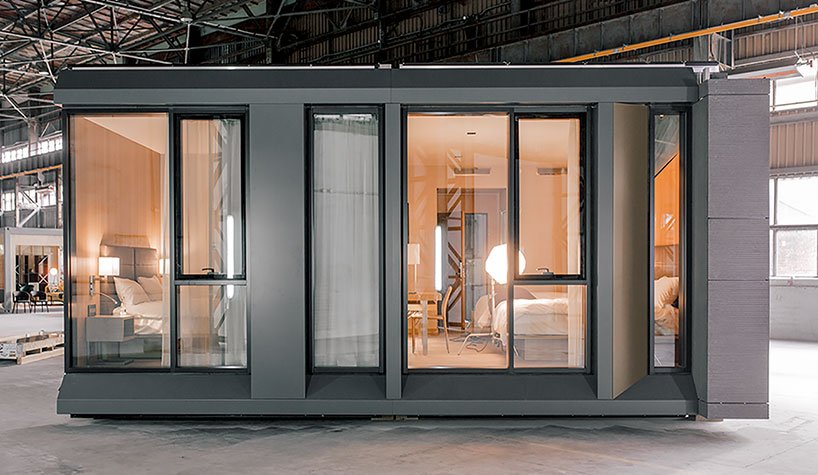
Module in production, Source: Danny Foster Architecture and DMDModular
CitizenM opened its first hotel at Amsterdam Airport Schiphol in 2008. Glasgow, London, New York, and Paris followed. The module traveled. Modules were manufactured in mainland Europe and China with furniture installed, televisions hung, and beds made before the room left the factory. Hilberts described the system: "The prefabricated room modules are inspected and signed off by a state inspector, weatherproofed, conditioned, and shipped to the construction site, ready to become the next CitizenM hotel."
The results were measurable. The Seattle South Lake Union hotel stacked at seven to eight modules per day, completing the hotel in 89 days, four months ahead of a conventional schedule. Construction waste was at 5%, compared with an industry average of 35%. The project achieved LEED Gold certification and a 24% reduction in energy use. These outcomes were not the product of a manufacturing strategy imposed on a hotel concept. They were the product of a hotel concept designed for mass production.
What Both Models Prove: The Brand as a Standard
Set side by side, Marriott and CitizenM illuminate the same mechanism from different entry points.
The brand standard is a product specification
Marriott's room dimensions, structural bays, and mechanical interfaces are manufacturing parameters expressed in hospitality language. Every developer building to the Courtyard standard is producing a component that the supply chain can learn to build efficiently. Marriott didn't need a manufacturing strategy; it had already encoded one in the flag system.
Supply chains respond to repetition
A factory invests in tooling when it can see a pipeline of identical orders extending into the future. Marriott's franchise system produces that pipeline across hundreds of properties annually. CitizenM's single module type produces it even more cleanly. Volume alone is not what industrializes a supply chain; volume of the same thing is.
Designing for manufacture eliminates translation loss
CitizenM resolved the problem Marriott spent a decade trying to solve: how to get a product conceived for on-site construction to work efficiently in a factory. The answer is you start over. A product designed for manufacture has different geometry, tolerances, and supply chain requirements than a site-built product with manufacturing applied afterward. The module was CitizenM's founding decision. The manufacturing logic before the first hotel, not after the tenth, is the difference between the two companies' trajectories.
The acquisition closes the loop
When Marriott paid $355 million for CitizenM in 2025, CEO Anthony Capuano cited "meaningful global growth potential". He drew a direct comparison between the AC Hotels acquisition and Marriott's track record of supporting the growth of acquired lifestyle brands. What Marriott bought was not the existing portfolio; it was the system for producing new properties. A factory-native development process for high-yield urban rooms, without the translation cost of retrofitting manufacturing onto a site-built template.
The Limits
The hospitality sector has structural characteristics that make standardization easier to enforce than most construction markets. Marriott’s flag system provides a direct mechanism for developers to meet brand standards, as the flag carries financial value that they cannot replicate on their own. Not every construction market has this, and many have unique relationships that can create leverage: a balance sheet constraint, a contractual penalty, or a program mandate may serve as catalysts for alignment. In NVR's case, it is the balance sheet—the land-option model that removes the financial incentive to customize. Any developer attempting standardization needs to identify their equivalent mechanism, because commercial pressure to vary the spec will always arise, and cultural discipline alone will not hold it back.
CitizenM's model works because the product is small, highly repetitive, and tolerant of the tight dimensional tolerances required by factory production. The transition from a 14-square-meter hotel module to a 90-square-meter family apartment, with varied layouts and structural requirements, is significant. The factory logic applies, but it requires the same or greater investment in product definition that CitizenM made at its founding.
Demand discipline is necessary but not sufficient. Marriott's candid admission that finding enough module manufacturers remains a battle is the most important single data point in this case. The brand held the spec. The franchise system aggregated the demand. The supply chain still hasn't fully organized to meet it. Marriott struggled to find regional suppliers for its flagship AC NoMad, while CitizenM built a regional supply chain for Europe and sourced from China for the rest of the world. Demand and supply must be considered together to grow together.
Where to Start
The Marriott & CitizenM argument reduces to one primary question:
What is your standard specification, and what mechanism maintains it?
A hospitality developer with a regional portfolio can generate a demand signal similar to CitizenM's by defining a standard guestroom module with fixed dimensions for floor-to-floor height, bathroom pods, and mechanical rough-ins. By holding this standard across five consecutive properties, the developer creates the precision required for off-site manufacture to become a rational choice once volume justifies the investment.
A housing developer who locks in a standard bedroom configuration, a common-area kit of parts, and a structural bay across a university system portfolio is emulating Marriott’s brand-flag strategy. This approach relies on repeated commitment to a defined product, giving the supply chain a clear reason to invest in specialized production.
A corporate real estate team standardizing a fit-out specification with fixed ceiling heights, power grids, and demountable partition systems across a national portfolio creates forward visibility. Committing to this specification for at least three years provides the stability that drives supply chain investment.
If your organization doesn't have a structural reason, the spec won't drift under commercial pressure, and the standard will erode before the supply chain can respond.
For Marriott and CitizenM, the brand is the standard.