Ford Model T: The Price That Built the Market
In 1906, Henry Ford looked out at America on the cusp of an industrial boom and saw a vast, untapped longing. He told a colleague he wanted to build a car for the multitude. At the time, this was not just ambition; it was a profound provocation.
The automobile was a rich man's toy—a bespoke, unreliable novelty for the wealthy, custom-built by skilled craftspeople. For the average factory worker, the dream of owning a car was not merely unaffordable; it was an absurdity. Ford’s genius was not mechanical, but empathetic and economic. He grasped that the true market for the automobile did not yet exist; it lay dormant, waiting for a price point that would unlock the aspirations of an entire nation.
He committed not to serving the first mover, but to building the mass market.
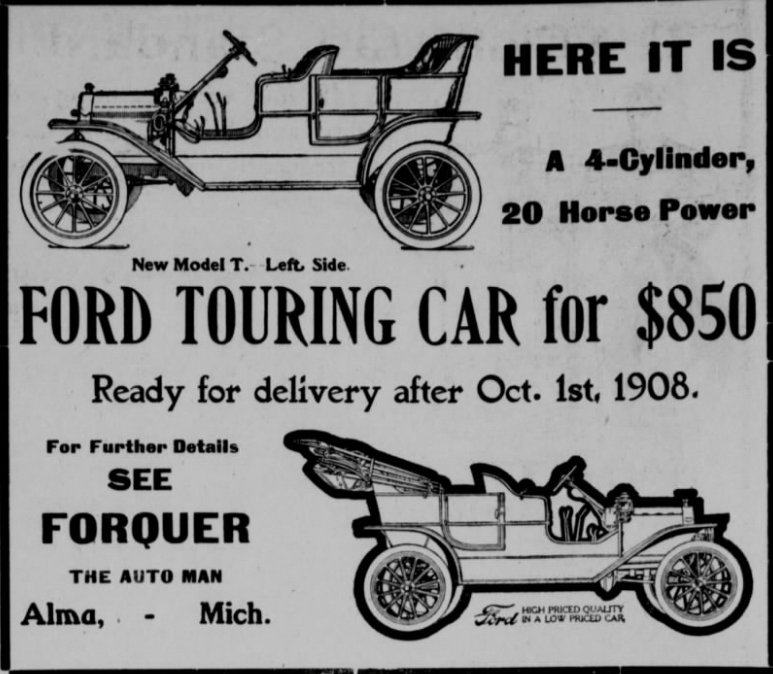
An early Ford advertisement for the Touring car, the Model T. Source: Alma Record, 1908
The Intervention: The Audacity of Price
Ford’s insight was not simply that he could manufacture cars more efficiently. It was that price that could create demand.
A $2,000 car served the wealthy.
An $850 car reached the prosperous middle.
A car below $500 began to change the country.
A car below $300 made the worker a customer.
That was the audacity of the Model T.
The Model T launched in 1908 for $850, already half the cost of many competitors, but Ford treated that price as the starting line, not the destination. The real goal was to drive the price down year after year until the automobile became a mass-market product.
Everyone remembers the moving assembly line, introduced at Highland Park in 1913. It is seen as the central innovation, but it was merely the consequence. It was the only possible answer to the economic constraint Ford had already imposed on his system: the car had to get more affordable.
Ford did not merely serve demand.
He designed the price point that gave rise to it.
That price target forced the production system to change. Ford could not hit the price with a bespoke product. He could not hit it with endless options. He could not hit it with skilled workers fitting parts by hand. He could not hit it with a product that changed every year. So he removed the variation.
Ford had decided that the future market was bigger than the current market, but only if the product could become radically more affordable. To reach that future market, the product had to be stable enough for the production system to learn. In 1909, Ford made the company’s most important demand-side decision: it would produce only the Model T. One basic platform. Minimal options. Eventually, famously, one color.
The factory had to be designed around a product that did not keep changing. The moving assembly line was the visible breakthrough. The invisible breakthrough was the price target that made the assembly line necessary.
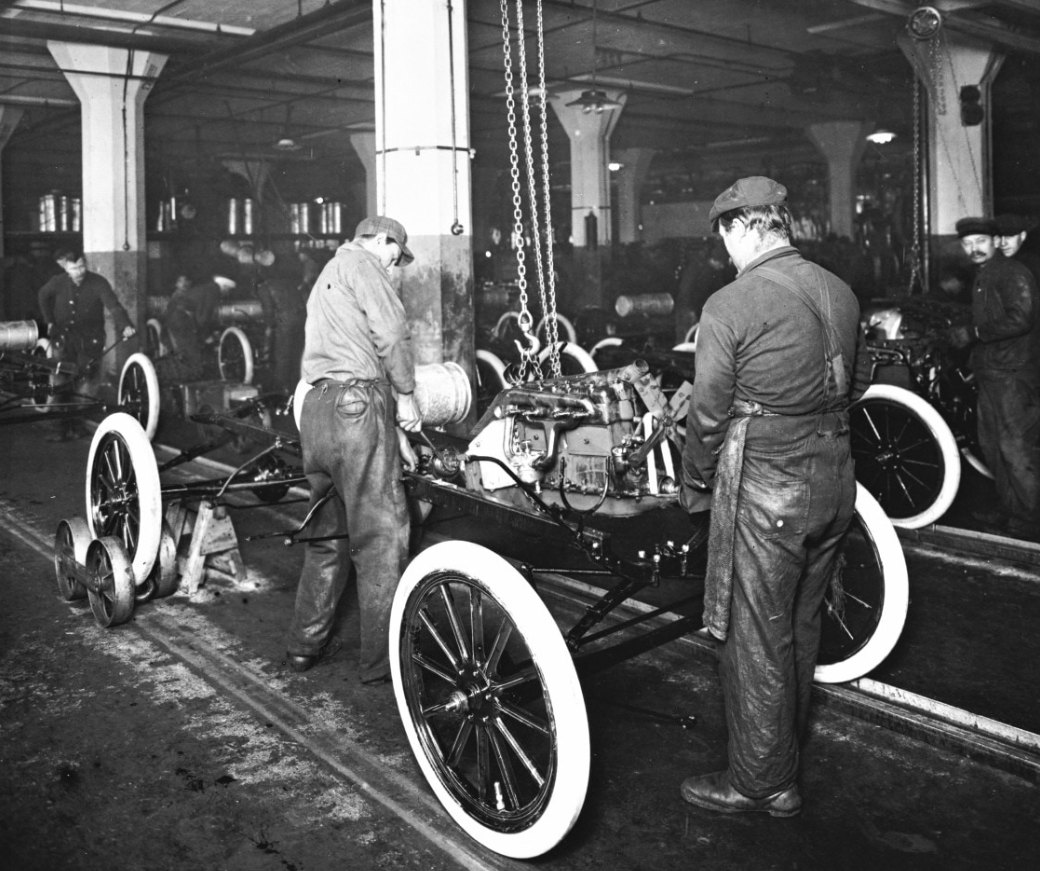
Make it stand out
Highland Park Ford Plant, 1913 — workers at fixed stations as the Model T chassis moves through.
Source: Henry Ford Museum
And once the system began to learn, the market opened.
Production rose from roughly 10,000 Model Ts in 1908 to more than two million annually by the mid-1920s. The price fell from $850 to under $300. Each price reduction pulled a new layer of buyers into the market: professionals, tradespeople, farmers, rural families, and eventually the very workers building the cars.
The price fell because the system learned. The system learned because the product stayed stable. The market grew because the price crossed the threshold where millions of people could finally say yes.
The Model: The Discipline of Working Backward
Ford did not start with the existing cost of a car and look for efficiencies. He started with the market he wanted to unlock and worked backward. He identified the price point that would make the automobile accessible to the masses, then forced every downstream production decision to meet that constraint.
The price target came first; the production miracle followed.
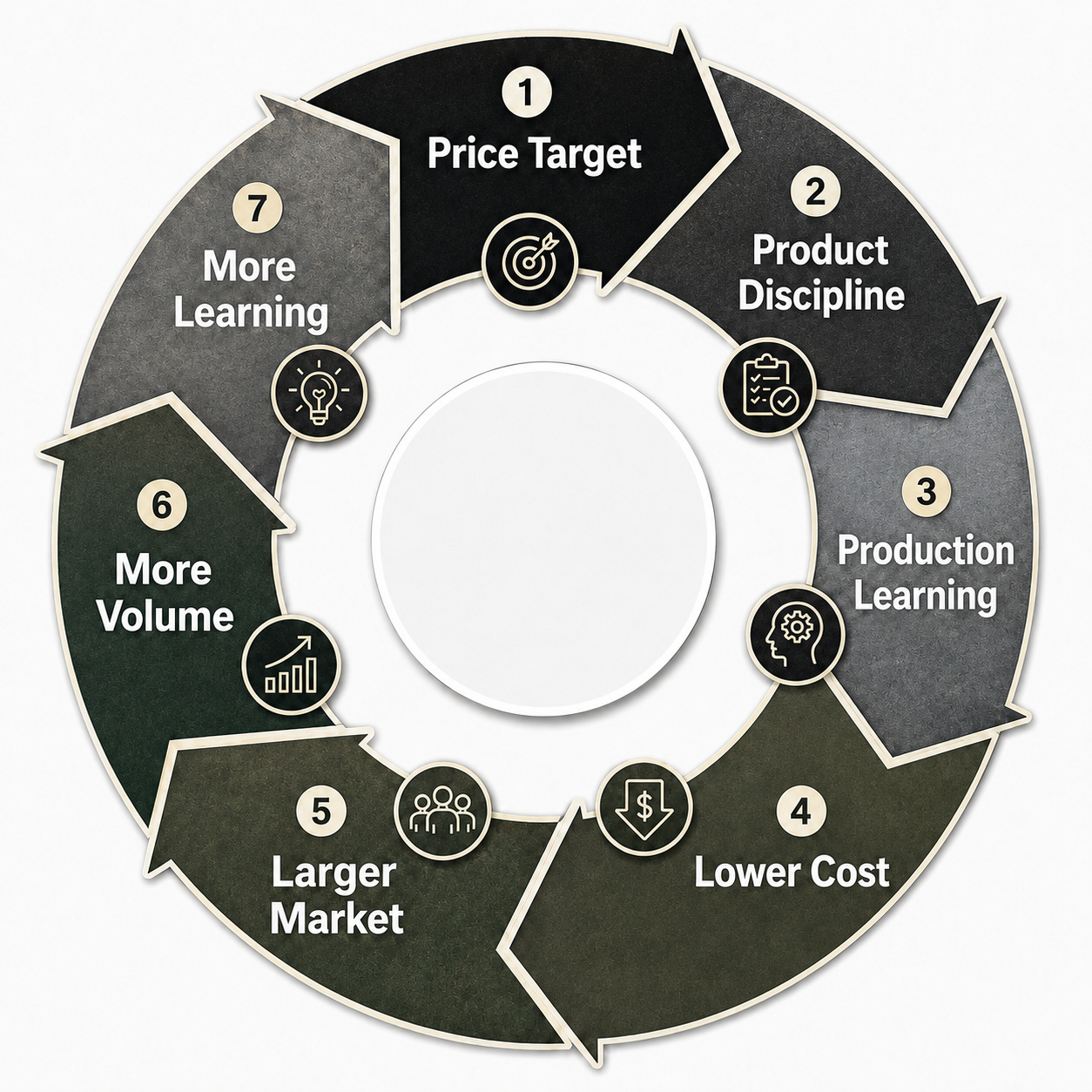
The Ford Model T Flywheel
A market-making price creates a product constraint. That constraint imposes a specific discipline, allowing the system to learn.
Learning lowers costs, expanded markets create volume, and volume accelerates further learning.
For modern infrastructure, the lesson is methodological. The question is not whether we can build a slightly more affordable version of today's bespoke projects. The necessary strategic question is: At what price point does a constrained market become a mass market?
To find that threshold, buyers must ask:
At what price does a starter home become attainable again?
At what installed cost does distributed energy become routine instead of premium?
At what delivery cost can counties repair roads before they fail?
At what facility cost can rural communities replace aging hospitals, clinics, or water systems?
Price targeting is market creation, not budgeting. Most buyers start with a known product and ask for a price; Ford started with the market and asked what the product must become. If a developer or agency preserves project variation while hoping for factory efficiency, they aren't following the Ford model—they are simply asking industrial suppliers to participate in a project-based process.
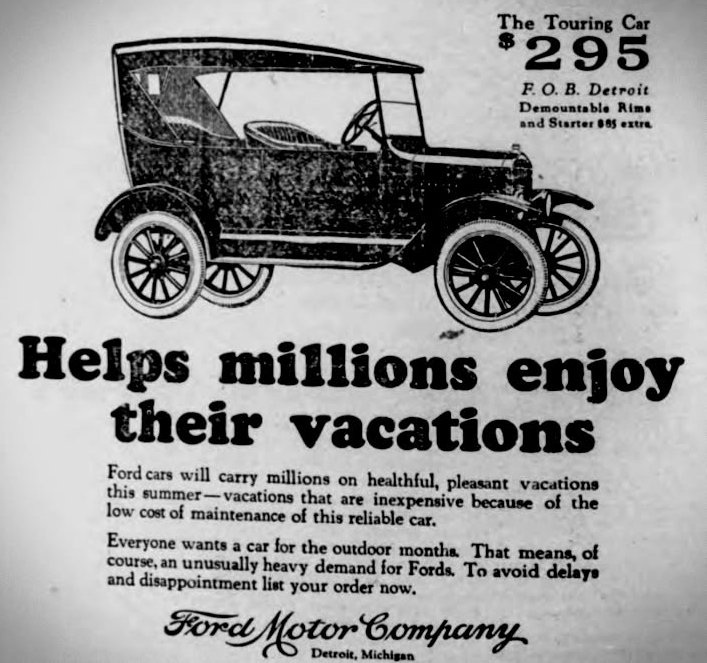
1925 Ford advertisement, highlighting the current price. Source: Detroit Free Press
The buyer’s task is to separate what the market truly requires from what the incumbent system has taught everyone to expect. Ford chose the constraint before he designed the system.
The pilot is the enemy of the learning curve if it never becomes a program.
The constraint was the strategy, and it is a useful connection to modern “working backward” and “first principles” strategic methods. Steve Jobs framed the iPod around a user promise: “1,000 songs in your pocket.” Amazon institutionalized working backward through customer-centered narratives such as PR/FAQs. Eric Ries popularized the Lean Startup method as a way to test assumptions through minimum viable products and validated learning. None of these is directly the same as Ford’s price target, but they share the same discipline: start with the customer threshold, then work backward to the product and system required to cross it.
The Limits
The Ford Model T case is powerful, but it is dangerous when copied without understanding its constraints.
The Risk of Over-Standardization
Ford’s customers accepted limited choices because the tradeoff was access: a car, or no car. Standardization is tolerable only when the value of the final product outweighs the sacrifice of choice. Modern buyers must define the acceptable quality floor and hold that stable, recognizing that not every element can be locked due to clinical, site-specific, or cultural realities.
The Trap of Brittleness
Ford’s rigid system struggled to adapt when General Motors introduced variety and annual model updates. The discipline that created dominance became institutional paralysis: retooling required shutting down production for months. Product lock is effective during the learning phase but dangerous without a well-defined path for evolution. The question is not whether to standardize, but how to standardize while retaining the capacity to evolve.
The Need for Demand Commitment
Ford could name the price at $300 because he believed a mass market would emerge at that price. For modern infrastructure, the price target is just a wish unless demand is organized before the factory commits. The price target must be paired with a demand commitment that includes a specific volume, time frame, and specification stability. Without this commitment, the supplier bears all the industrialization risk, resulting in another pilot rather than a learning curve.
The Cost of Deskilling Labor
Ford’s task decomposition increased throughput but created social costs by making work repetitive and alienating, contributing to labor unrest. A modern industrial strategy should not remove skill from the system simply to cut costs. Instead, the goal is to move skill to where it creates the most value: production engineering, logistics planning, and continuous improvement.
Where to Start
Ford’s Model T lesson is simple: Determine the price target that unlocks mass-market adoption, then enforce the product discipline required to reach it.
This reversed sequence—setting the market threshold before designing the system—is the starting point for industrialization.
For Multifamily Developers: Stop asking what modular costs on a single project. Instead, ask: what rent level unlocks an underserved market, and what unit design and delivery model are required to hit that level consistently?
For Utilities: Stop requesting one-off cost reductions for bespoke assets. Instead, ask: which grid components could become standard products, and at what price does their deployment become routine?
Industrialization does not occur when suppliers are asked to innovate harder; it occurs when buyers define a price that matters and commit to the stability the system needs to learn.
The price falls because the system learns, and the system learns because the product remains fixed.