Ford’s Flow and Manufacturing Mindset
The System Behind the System
There is a version of the Ford story that the construction industry has been telling itself for thirty years. Henry Ford invented the assembly line, and it made cars cheap. If construction were to adopt the assembly line and its modern equivalents—prefabrication or modular building, or lean construction—the same transformation would follow.
This version is not wrong exactly. It is incomplete in a way that makes it useless. The assembly line was not the invention. It was the output of a prior decision about how to organize an entire production system around a single, stable objective.
The moving line at Highland Park in 1913 was the visible surface of something that ran much deeper: a manufacturing philosophy that Ford had been building, consciously and methodically, for years before the first chassis moved down a track.
The Supply series has covered three versions of industrialization so far. Kaiser showed what happens when production is redesigned for throughput under extreme time pressure. Levitt showed how a site-based system can be sequenced like a factory when the product is constrained, and the workforce is organized around flow. Bechtel showed how integration—one entity coordinating the whole system—manages complexity, and why managing complexity is different from eliminating it.
Ford is where all three converge, and are taken further, held together longer, and optimized more relentlessly.
The Intervention
Three decisions preceded the moving assembly line and made it possible:
Product lock: In 1909, Ford announced the company would produce only the Model T—one car, one color, without meaningful customization—for what turned out to be nineteen years.
Parts standardization: Ford's engineers spent years ensuring that any component produced by any process would fit any vehicle without adjustment, eliminating the skilled fitting required by craft production.
Task decomposition: the assembly process was broken down into the smallest constituent operations, each assigned to a dedicated worker who performed one step in a specific sequence at a specific pace.
Only after those three decisions were in place did the moving assembly line become possible, and when it came to Highland Park in 1913, it did not feel like an invention; it felt like an inevitability. Assembly time per vehicle dropped from roughly twelve hours to under ninety minutes. The price of the Model T, $850 at launch in 1908, fell below $300 by the mid-1920s.
The River Rouge complex, fully operational by the mid-1920s, extended the logic to its limit. Iron ore and coal arrived by ship at one end. Finished automobiles departed from the other. In between: steel production, glass manufacturing, engine assembly, body fabrication, final assembly—all under one management system, all organized around the principle that every external dependency was a source of variability, and variability was the enemy of flow.
Ford's 1914 decision to double the prevailing wage to $5 per day is usually read as philanthropy or proto-consumerism. The operational reading is more instructive. Turnover at Highland Park before 1914 was catastrophic, with annual rates exceeding 300% in some departments. Every worker who left was a unit of trained capacity that had to be rebuilt from scratch. In a system where the efficiency of the whole depended on the consistency of every station, that turnover was a direct drag on throughput. The $5 day was the price of system stability.
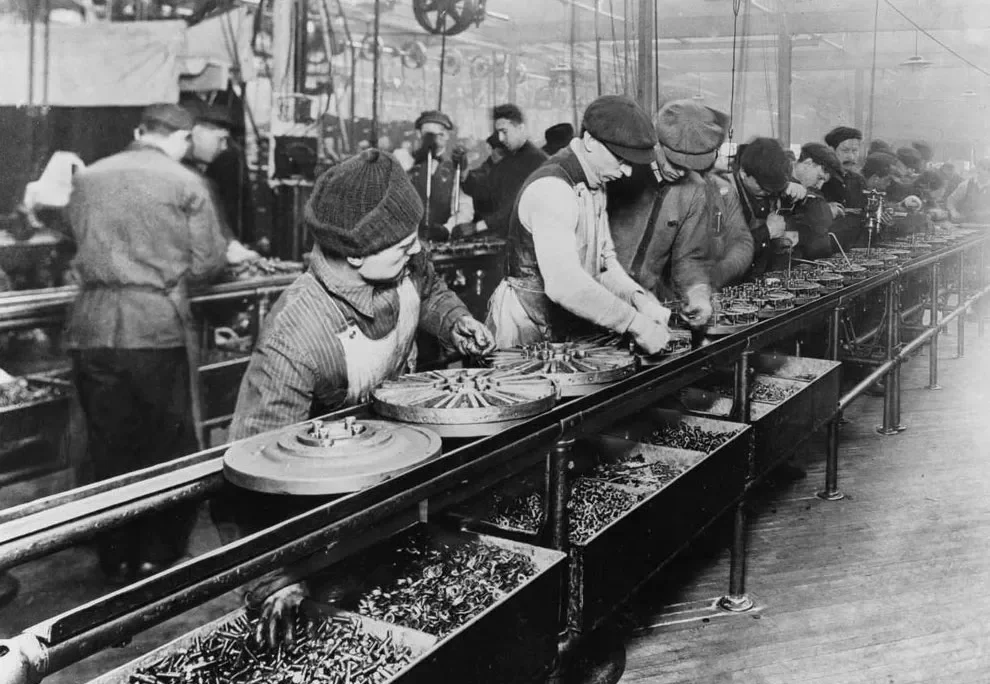
The Ford assembly line in 1913. Source: Wikimedia Commons/public domain
The Model
Ford built a closed-loop production system in which five interdependent elements reinforced each other—and in which the removal of any single element would have degraded the whole.
Flow over sequence. Traditional manufacturing was sequential: complete one step, move to the next. Ford replaced the sequence with flow—the continuous movement of work through fixed, specialized stations, all operating simultaneously. The productivity gain was not in making any individual step faster. It was in eliminating the dead time between steps.
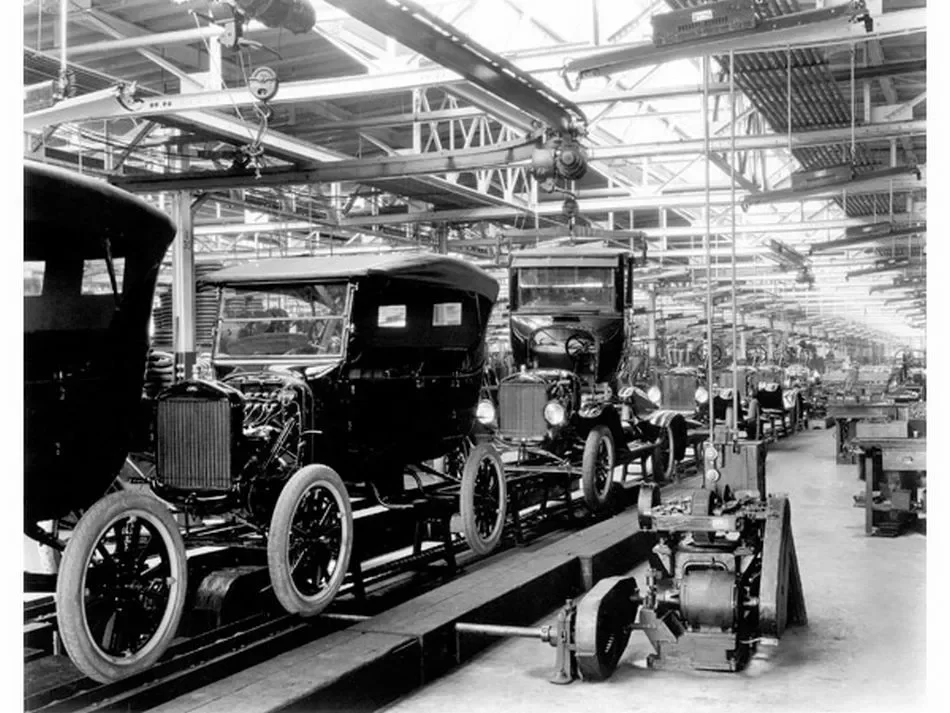
Ford moving assembly line. Source: Smithsonian
Task specialization at scale. As each task became simpler, the system became more capable. A worker who performed one operation repeatedly became extraordinarily fast and consistent at it. The variability that characterized craft production—and that made prediction and scheduling impossible—was driven out of the process.
Vertical integration as system control. River Rouge was not about owning things for its own sake. Every external dependency was a source of variability. Integration eliminated the supplier variability that disrupted flow. For modern construction, the analog is not ownership of suppliers—it is tight interface management: standardized component dimensions, coordinated delivery schedules, shared design platforms, contractual structures that align supplier incentives with system throughput.
"The construction industry keeps importing the assembly line. The lesson lies in the three decisions that made it possible: product lock, parts standardization, and task decomposition. Without those, the line is theater."
Workforce stability as system infrastructure. The $5 day was system maintenance. Workforce stability is not a labor relations aspiration—it is a production system requirement. Learning cannot compensate for a churning workforce.
Learning as a structural advantage. The system got better as it ran. A stable product, a fixed process, a consistent workforce, and management attention to throughput created the conditions for learning to compound continuously. This is designed-in, not accidental.
The Limits
The same product lock that made the Model T production system so efficient made it almost impossible to change. When General Motors introduced annual model updates in the 1920s, Ford's response was institutional paralysis. River Rouge was tooled for one product. Retooling required shutting down production entirely for months. The lesson is not that standardization is wrong. It is that standardization without a designed path to evolution creates brittleness.
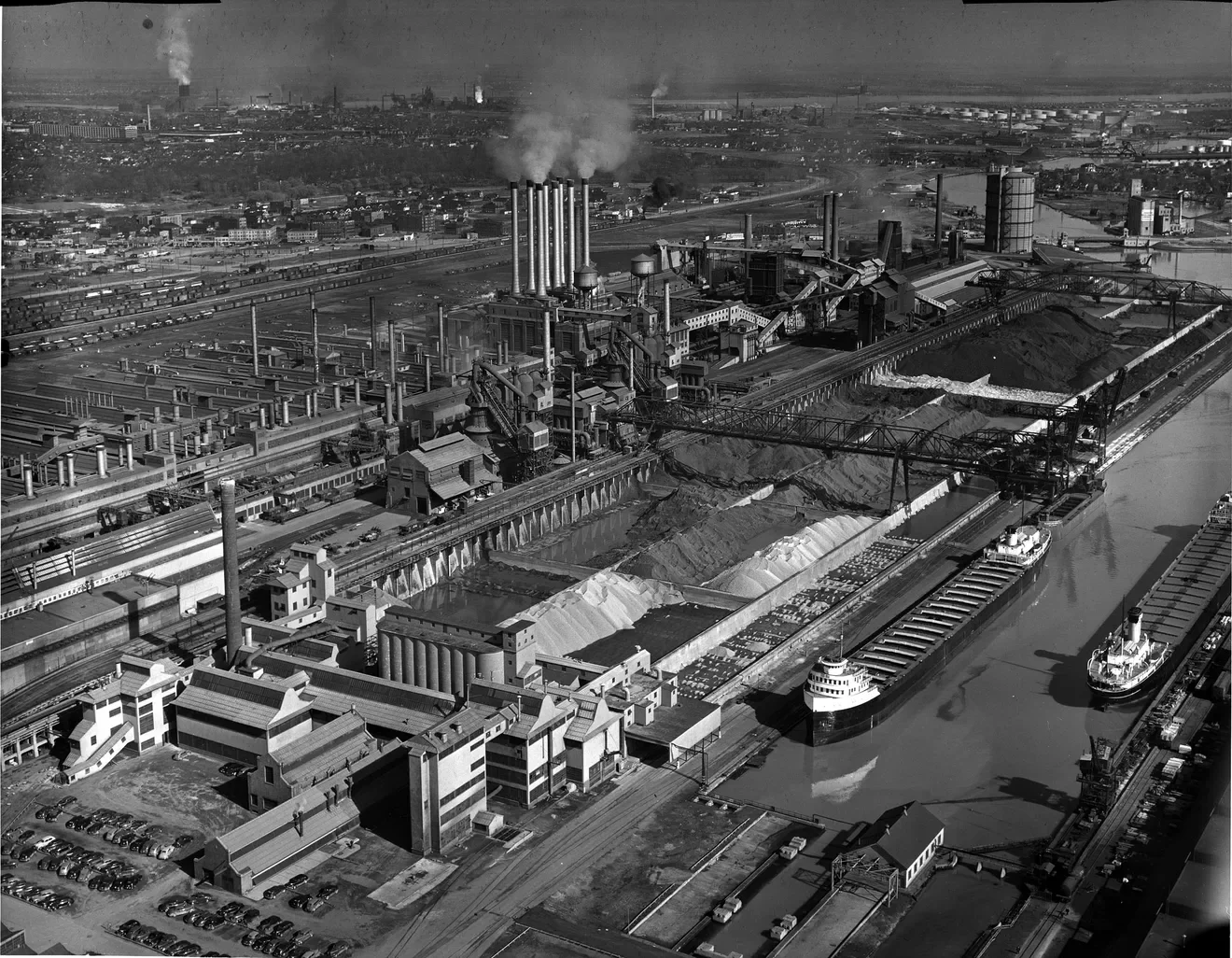
River Rouge plant in full production from raw material to automobiles. Source: Public Domain.
Vertical integration has a ceiling. River Rouge was a maintenance challenge that scaled with complexity. As the automobile product became more sophisticated, the model became increasingly impractical. The modern supply chain answer is not more vertical integration—it is tighter interface management across independently owned but tightly coordinated participants.
Deskilling extracts a social cost that eventually returns as a system cost. Ford's task decomposition produced a workforce with no stake in the system beyond their individual station. The labor unrest of the 1930s was in part a consequence. A construction system that deskills its workforce to reduce training costs will encounter problems with turnover, quality, safety, and organized resistance.
Where to Start
The Ford argument reduces to one question: Are you building projects, or building a system that delivers them?
A general contractor or manufacturer who has never formally made the three pre-assembly-line decisions—product lock, parts standardization, task decomposition—for their core building type is not yet running Ford's process. The starting point is not technology investment. It is the decision to build the same thing, to the same spec, with the same workforce, long enough for the system to learn.
A prefabricated component manufacturer whose product catalog changes with each client request has not made the product-lock decision. The discipline to hold a standard product against client pressure to modify it is the manufacturing decision that precedes every efficiency gain in the production process.
An architect whose standard of practice is to design every project from first principles, treating repetition as a failure of creativity rather than a source of capability, is Ford's inverse.
The manufacturing mindset at the design level asks: which elements of this building type can be fixed, not to constrain the design, but to enable the production system that will deliver it?
The line always comes last, always. Product lock, parts standardization, and task decomposition first, then the line follows as an inevitability rather than an investment.