B-24 Liberator and Willow Run: The Outside Eye
Industrial Logic Applied to Complexity
Henry Ford had no idea how to build a bomber, and that was the point.
When Ford's production chief Charles Sorensen visited Consolidated Aircraft's San Diego plant in 1941, he spent four days studying the production process. Consolidated knew how to build aircraft. Ford did not. But Sorensen saw something Consolidated couldn't see about itself: a craft shop with airplane-sized products. Skilled mechanics moved around the aircraft, fitting parts, correcting discrepancies, carrying the real production knowledge in their hands and heads. There was no orderly sequence, no continuous flow, no reliable interchangeability, no way to compound learning across repeated operations.
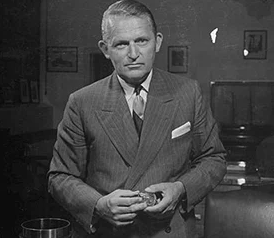
Charles Sorensen Source: Getty Images
His conclusion was brutal: Consolidated was not running a factory. And craft shops, however skilled, could not produce bombers at the rate the war required.
Ford’s response to that ignorance was the most instructive moment in this series, but Willow Run did not begin with Sorensen’s insight. It began with a demand shock large enough to make the existing production system visibly inadequate.
In May 1940, President Roosevelt had given American industry a production problem it had never solved before. The United States had fewer than 3,000 warplanes in its arsenal, many obsolete. Roosevelt called for 50,000 combat aircraft in twelve months—a number larger than the total number of airplanes the country had produced since Kitty Hawk. The Army Air Corps needed heavy bombers capable of reaching Germany's industrial heartland. The B-24 Liberator was at the center of that demand shock.
The scale of the ask made normal procurement logic collapse. There was no time to gradually develop new manufacturers. There was no room to protect incumbent producers from outside scrutiny. The demand was great enough, urgent enough, and public enough to force a different kind of question onto the table. Not: who already knows how to do this? But: who can figure out how to do this at scale?
That is why Sorensen's visit to San Diego mattered. He went not as a student of aviation but as a diagnostician of scale. Rather than studying aircraft manufacturing, Sorensen studied aircraft as a production problem—asking how a product with hundreds of thousands of parts could be decomposed, standardized, and assembled by a workforce with no prior aviation experience in a factory that didn't yet exist.
The answer was Willow Run: a mile-long plant in a cornfield outside Ypsilanti, Michigan, that at peak production delivered one B-24 Liberator bomber per hour. The facility didn't exist in 1940. By 1944, it was the largest room under one roof in the world, producing aircraft at a rate the professional aviation industry had declared impossible.
The Intervention
The B-24 was not a simple product. It was 67 feet long, weighed roughly 18 tons, contained hundreds of thousands of parts, and required 360,000 rivets in 550 sizes. It was an aircraft born inside a craft manufacturing system with incomplete standardization, changing drawings, field fitting, and a great deal of tacit knowledge held by a small number of skilled people.
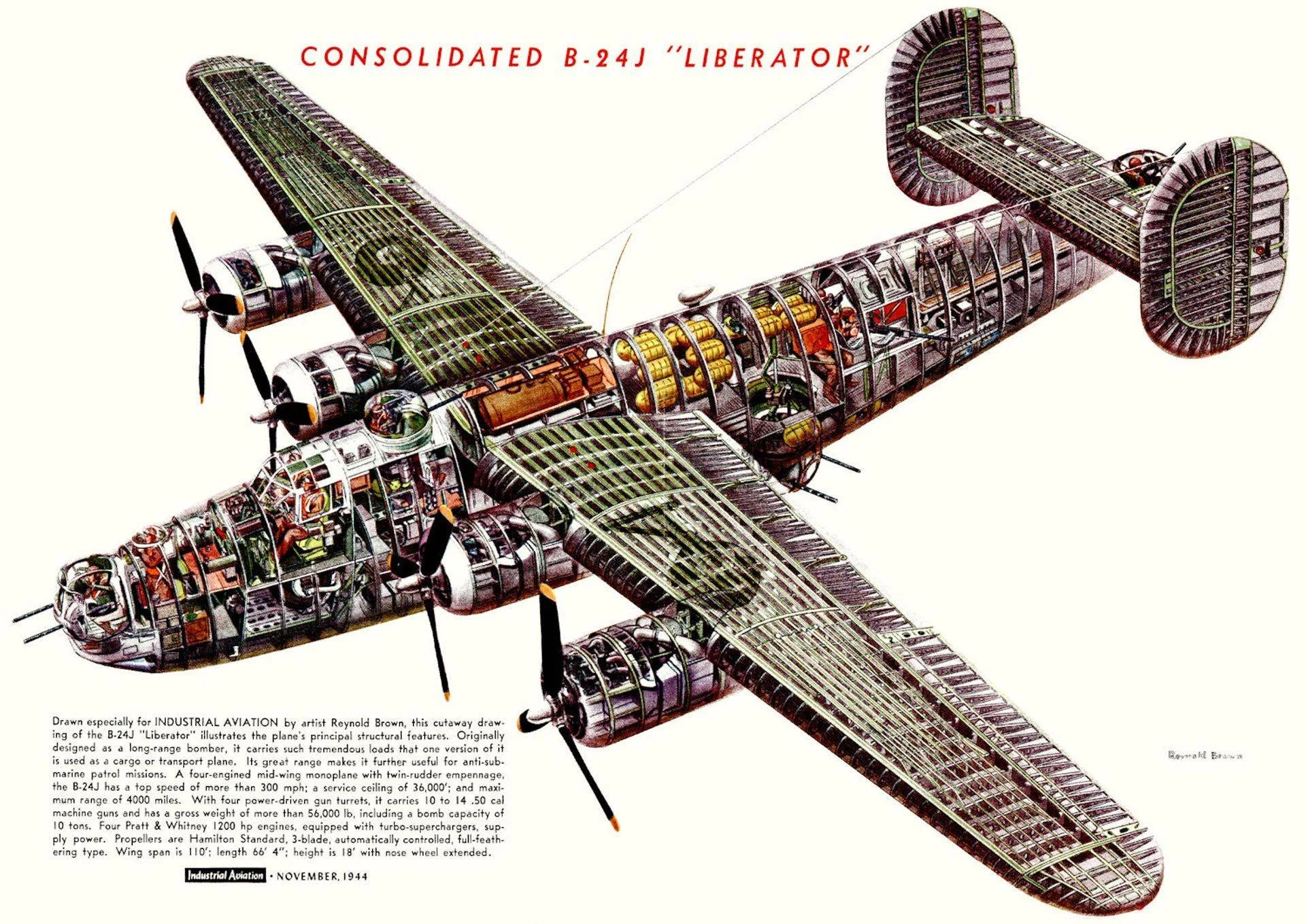
B-24 Cut Away
Sorensen's response applied the same logic that had produced the Model T to a product of radically greater complexity. But there is a common misreading of Willow Run that the construction industry should not repeat: the assembly line was not the innovation. The real innovation happened upstream, before a single aircraft moved down any line.
After walking Consolidated's plant, Sorensen reportedly stayed up through the night sketching a mass-production approach. When Ford was offered the opportunity to build only wings, Sorensen refused. His position was the whole plane or nothing. Ford could not industrialize the B-24 if it only controlled a fragment of the system. It needed authority over sequence, tooling, material flow, work design, and final assembly. The production system had to be designed as a system.
What followed was a translation effort of staggering scale. Ford’s teams traveled repeatedly between Dearborn and San Diego. They found that Consolidated's drawings were incomplete, inconsistent, and insufficient for mass production. Some production knowledge existed only in supervisors' memories. Ford had two B-24s flown to Dearborn, where they were taken apart piece by piece. A thousand-person tool design group worked for nearly a year to create three-dimensional schematics, millions of square feet of blueprints, and the tooling infrastructure needed to make the aircraft reproducible.
Ford designed 1,600 machine tools and 11,000 fixtures to stamp, mill, drill, broach, grind, locate, and hold parts with repeatable precision. The point was not to make the aircraft simple. The point was to make complexity teachable.
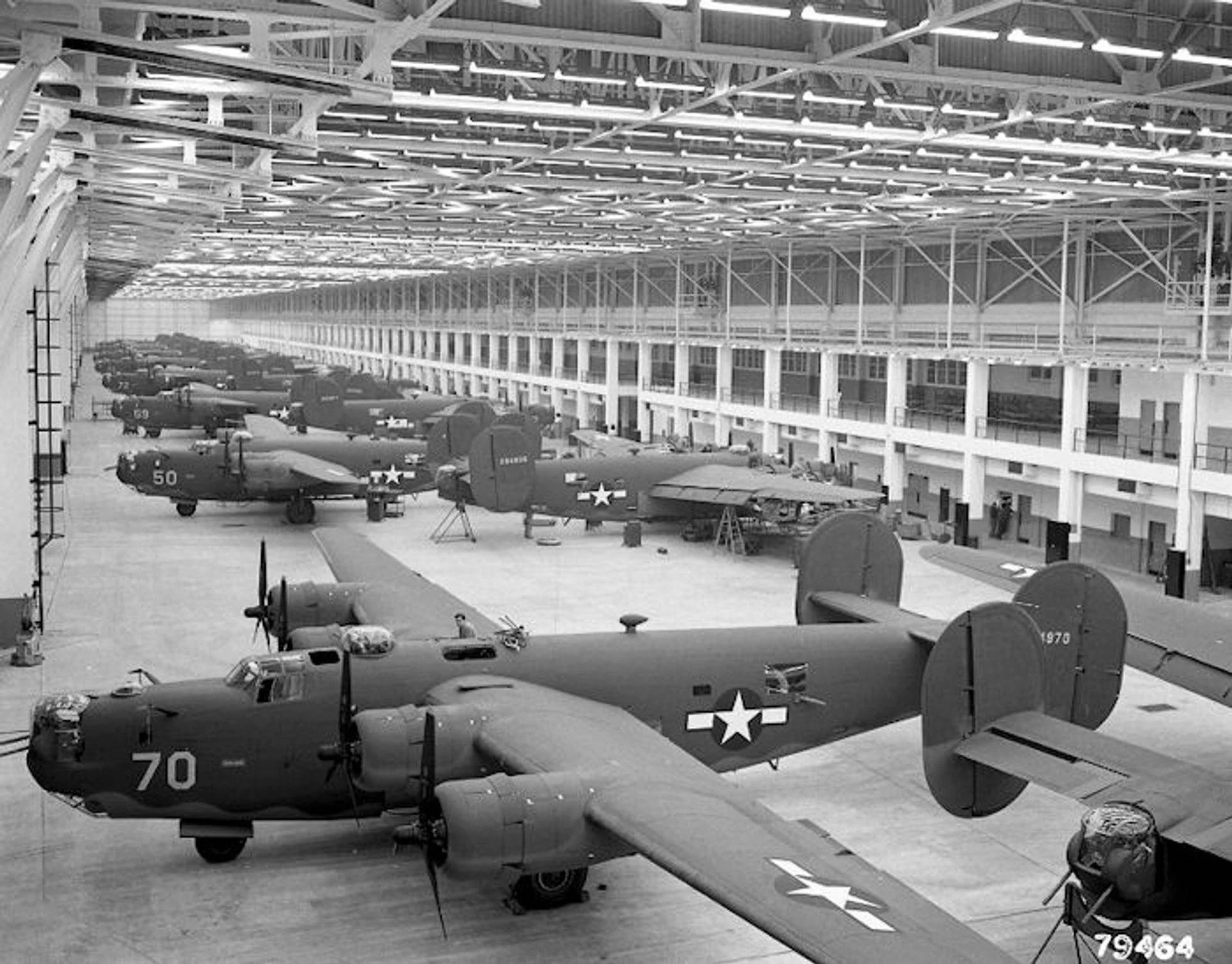
Willow Run Assembly Line in near peak production. Source: Library of Congress
It did not work immediately. And the real-time corrections are as instructive as the original design.
Ford's tool engineers had spent years working with automotive steel—hard dies, high tolerances, materials that behaved predictably under stamping and milling. Aircraft aluminum did not behave the same way. The hard steel dies that Ford initially deployed damaged the softer aluminum panels that made up most of the B-24's structure. Tooling had to be redesigned from scratch, costing months and significant money. The early assumption that automotive manufacturing knowledge could transfer cleanly to aircraft manufacturing was wrong in the places that mattered most.
The assembly sequence itself required continuous adjustment. Sorensen had divided the aircraft into major sections—center wing, outer wings, fuselage, nacelles, flight deck, nose, and tail—each moving through its own choreographed production sequence before final assembly. In theory, a clean decomposition, but in practice, the interfaces between sections revealed gaps that drawings had not anticipated. Subassemblies arrived at final assembly out of tolerance. Workers developed informal workarounds that reintroduced the craft fitting Sorensen had designed out. Supervisors had to identify which workarounds were masking real interface problems and which were genuine process improvements, then decide which to codify and which to eliminate.
The Army Air Corps added pressure from a different direction. Combat experience over Europe generated a continuous stream of modification requests—new armament configurations, updated defensive systems, performance changes driven by what pilots were actually encountering. Each request was operationally rational. Each one threatened to reset a portion of the production system. Ford's eventual response was not to refuse all changes but to enforce discipline around them: modifications would be batched, reviewed for production impact, introduced at defined intervals, and, where possible, routed to field modification centers rather than absorbed into the main assembly line. That discipline was not in the original design; Ford and Sorenson learned under pressure.
None of this was visible in the production rate figures. By mid-1944, one B-24 rolled out every 63 minutes. The accumulated correction in the tooling redesigns, the interface rework, the change-control negotiations, and the informal knowledge that supervisors had formalized made the rate possible. The real work was changing the design and holding everything constant before the assembly line could run.
Every component that entered the Willow Run assembly process was produced to tolerances tight enough that it would fit without adjustment. The workforce that assembled it did not need to know how to fit a part. They needed to know how to install one.
The factory itself was an artifact of this production logic. Albert Kahn designed a one-level industrial building more than 3,200 feet long, covering roughly 80 acres. It was not just a large building. It was a building designed around flow: material flow, subassembly flow, workforce movement, inspection, and aircraft delivery to an adjoining airfield.
Willow Run was a production system expressed as architecture.
The Model
Willow Run is the most instructive Supply case for industrialized construction, not because buildings are like bombers, but because the objections are identical: complexity, tolerance, customization, immature supply chains, scarce labor, unproven factories, early quality problems, and economics that only work at volume.
Demand commitment first
Willow Run began with a demand shock large enough to justify system redesign. Roosevelt's requirements created conditions under which the normal craft production system was visibly inadequate. Without that demand, the investment in plant, tooling, suppliers, training, and process redesign would have looked irrational.
Industrialized construction has repeatedly tried to begin on the supply side: a factory, a panel system, a module, a component catalog. Willow Run suggests the order is backward. The system begins with committed demand large enough to reward standardization. The owner is the Roosevelt figure because they create the demand signal that makes it rational for everyone downstream to behave industrially.
Product lock, or controlled change
The Army Air Corps wanted continuous design improvements: new armament configurations, updated engines, modified fuel systems. From a military standpoint, rational. From a production standpoint, chaos. Every change risked invalidating tooling, disrupting sequence, and resetting the learning curve.
Ford and the Army eventually reached a compromise. Willow Run would focus on stable production designs, and completed aircraft could be sent to field modification centers for upgrades. Changes would be batched and introduced at defined intervals rather than continuously.
That is a direct construction lesson. The alternative to endless project-by-project customization is controlled change architecture: stable production platforms, batched updates, defined release cycles, and post-production customization where necessary. The design isn’t frozen forever. The system evolves, but not during production.
Interface definition before factory investment
Ford could not build a B-24 per hour by relying on heroic fitters. It had to define the aircraft so parts, subassemblies, tools, and workstations aligned. Drawings had to be made complete and tacit knowledge had to be externalized. Component interfaces had to be precise enough for production to proceed without constant interpretation.
The construction parallel is direct. Industrialized construction does not begin with a factory. It begins with interfaces: structural grids, MEP connection points, wall-panel tolerances, bathroom-pod dimensions, lifting points, sequencing rules, and allowable variation. A building platform is not a style; it is an interface regime.
Tooling investment relocates skill—it doesn't remove it
Willow Run's jigs and fixtures did not make workers less skilled. They made the system more teachable, the work more repeatable, and skill progression more visible. Engineering knowledge moved into tooling, station design, and quality systems. That allowed workers with no prior aviation experience to perform precise operations repeatedly.
Ford created an Aircraft Apprentice School that trained up to 8,000 students per week. New workers included farmhands, secretaries, teachers, and clerks. At peak, the plant employed 42,500 workers, including 12,000 women paid the same hourly wage as men. The workforce was specifically skilled for a production context that required consistency at scale rather than versatility across projects.
The gender composition of Willow Run's peak workforce is not a historical footnote. It is evidence of what becomes possible when production knowledge is designed into the system rather than carried in scarce craft labor. When skill lives only in the worker, scaling requires years of apprenticeship. When skills are distributed across tools, training, sequence, and station design, the labor pool expands.
The goal of industrialized construction is not to produce disposable labor. It is to produce clearer skill ladders: defined entry points, measurable task competency, and visible progression from one production role to the next.
Supplier orchestration, not vertical purity
As production matured, Willow Run relied on nearly 1,000 Ford factories and independent suppliers for parts and subassemblies while concentrating on predictable aircraft assembly. The factory was one node. The deeper capability was supply-chain choreography.
Industrialized construction is not simply factory-built buildings. It is orchestrated production across suppliers whose outputs fit into a controlled system. The manufacturer who insists on building bespoke capacity into fragmented demand forfeits the compounding advantage that Willow Run eventually demonstrated.
Learning under volume compounds
Willow Run did not hit plane-per-hour production immediately. It took years of redesign, rework, process stabilization, supplier coordination, and change-control negotiation. But once the system stabilized, labor hours per aircraft fell steadily. By mid-1944, Willow Run was producing one B-24 per hour and accounted for roughly half of all B-24s assembled that year.
Committed demand creates volume, and volume justifies tooling. Tooling enables repeatability, and repeatability enables learning. Learning lowers cost and increases throughput. No step in that flywheel sequence works without the one before it.
The Limits
Willow Run should not become a clean parable. It was messy, late, expensive, politically enabled, and quality-constrained.
The early story was not "plane per hour." It was "Willit Run." No B-24s were mass-assembled until late 1942. The first 56 aircraft were not combat-ready and were assigned to training and transport duties. Ford initially used hard steel dies appropriate for automotive parts, which damaged the softer aluminum that made up most of the B-24's structure; thus, the tools had to be redesigned, wasting months and money.
The labor system was also fragile. Willow Run was built in a rural location far from Detroit's labor pool. Workers faced long commutes, inadequate roads, housing shortages, and a factory environment so overwhelming that many quit after their first day. Temporary dormitories, trailer parks, prefabricated housing, and new highway infrastructure were all required for the workforce system to function.
Willow Run only worked when the broader deployment system caught up to the factory.
That is a warning construction cannot afford to ignore. A production system is not only about products, manufacturing plants, and processes. It is also housing, transportation, training, retention, suppliers, inspection, and governance across the supply chain. A factory that outpaces its surrounding system does not industrialize construction; it just relocates the disorder.
The quality limits were real too. Early B-24s required extensive rework before they were airworthy. A system optimized for throughput can hide invisible rework cost. Factory speed is not the same as system productivity. If defects move downstream into the field, the factory has not solved the problem; it has shifted it.
The B-24 was not designed for mass production, and Willow Run proved that manufacturing logic could be imposed on a product, but it does not prove that this is the optimal approach. The B-29 was later designed for mass production by Boeing and serves as an example of design for manufacturability.
The deeper lesson for construction is not merely to industrialize the building process; it is to design the building product for industrial production from the beginning. That is the difference between using a factory as a rescue mechanism and using production logic as a design discipline.
Where to Start
The Willow Run question for industrialized construction is simple:
Are you treating your building type as a craft domain or as a production problem?
A general contractor building schools, hospitals, or multifamily housing across multiple programs can still treat each project as unique. That is the Consolidated model: skilled people managing variation one building at a time. It produces good buildings, but the system does not compound over long periods of time.
The Willow Run alternative asks: what would it take to decompose this building type into repeatable sections, define interfaces precisely enough that components fit without field adjustment, sequence work so learning compounds, and build a workforce system that scales beyond scarce master craftspeople?
An owner with a repeatable portfolio carries the most consequential role. Without committed demand, nothing downstream can rationally invest. Suppliers will not tool up, manufacturers will not standardize, designers will not constrain variation, and workforce organizations will not build task-specific pathways. The owner is the Roosevelt figure in the system.
An architect or engineer carries the Sorensen-equivalent responsibility. The job is not only to design a good building. It is to translate building intent into interfaces, tolerances, connection details, assembly sequence, and permissible variation. In industrialized construction, drawings are not merely instructions. Architects and engineers must inform production infrastructure.
A manufacturer or supplier has to resist the temptation to sell bespoke capacity into fragmented demand. The real value is a production system that improves by repeatedly making defined things, not a factory that can make anything.
A workforce developer should stop treating every labor challenge as a shortage of fully formed generalists or highly skilled tradespeople. Task-specific training, measurable competencies, production-cell progression, and clear advancement pathways expand the labor pool without pretending the work is unskilled.
Public agencies should reckon with the uncomfortable truth: Willow Run worked because demand, procurement, infrastructure, labor, training, roads, housing, suppliers, inspection, and modification capacity aligned. Alignment required public investment and political will to influence the full supply chain in modest ways. Lots of small interventions were needed, with the only mandate being the demand signal.
The lesson is not "build houses like cars”, "put construction in a factory", or "deskilling will solve labor." The lesson is harder and more useful: industrial production only works when demand, design, tooling, labor, suppliers, quality, and change control organize as a system.
Sorensen asked what kind of production system a bomber would require, and that is the question construction has avoided for too long.