Bechtel: Integration as Capability
The Bridge and the Trap
Bechtel did not industrialize a product, and it did not industrialize a process. What Bechtel industrialized was the management of complexity—the organizational systems, contractual structures, and coordination capabilities that allow projects of staggering scale and interdependence to be delivered without catastrophic failure.
Managing complexity is a real and valuable capability, and for the right problem, it is the only answer.
But the Supply series has argued that industrialization requires moving from managing complexity to eliminating it, while moving from coordination capability to manufacturing capability, from a system that absorbs fragmentation to one that removes it.
The capability story: In the framework the Supply Overview introduces, Bechtel is the series's most instructive anomaly:
Platform Coordination from Stage 4 to Stage 5 Product from Stage 1 to Stage 2
Process capability from Stage 2 to Stage 3
The case demonstrates that Platform Coordination capability can be developed independently of Product and Process capability—and that when it is, the result is not industrialization. It is the optimization of a fragmented system. That is the distinction the series is designed to make visible.
Bechtel represents the moment where those two paths diverge—understanding why they diverge and which path leads where is the most useful thing this case offers.
Bechtel is the bridge. Bechtel is also, in certain conditions, the trap.
The Intervention
Warren Bechtel founded the company in 1898 as a railroad grading contractor. His son, Stephen Bechtel Sr., transformed it into the dominant force in American heavy engineering through a series of projects that redefined what a private contractor could accomplish.
The Hoover Dam consortium was a group of six Companies, with Bechtel as a founding member, who completed what was then the largest dam in the world in 1936, on time and under budget. The achievement required coordinating over 5,000 workers, managing dozens of subcontractors, sequencing concrete pours with precision that had never been attempted at that scale, and solving engineering problems without precedent. The organizational and contractual architecture that made the consortium function was substantially Bechtel's work.
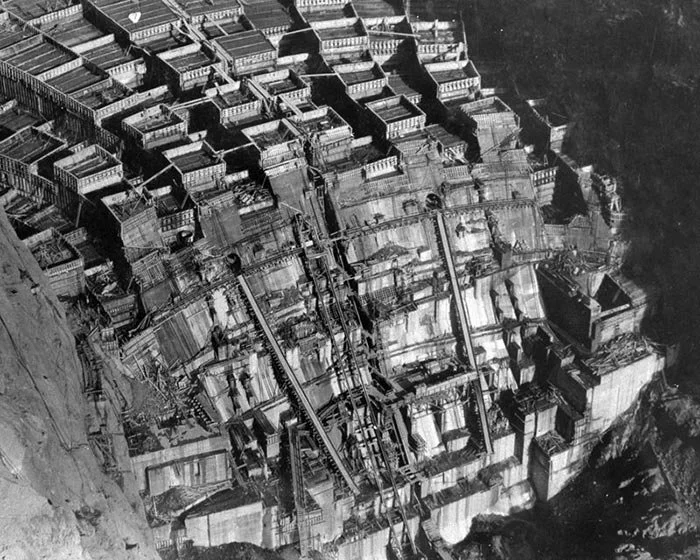
The Hoover Dam construction, c. 1934. The scale of coordinated concrete placement, the organizational achievement visible in the precision of sequential poursSource: Library of Congress
The postwar decades confirmed the model. Bechtel built the Trans-Arabian Pipeline across 1,068 miles of desert. It built refineries, chemical plants, and nuclear facilities on six continents. It built the Bay Area Rapid Transit system, the Channel Tunnel's ventilation infrastructure, and the reconstruction of Kuwait's oil fields after the Gulf War. Each project was defined by a characteristic most contractors avoided: genuine complexity, genuine scale, and genuine risk of coordination failure.
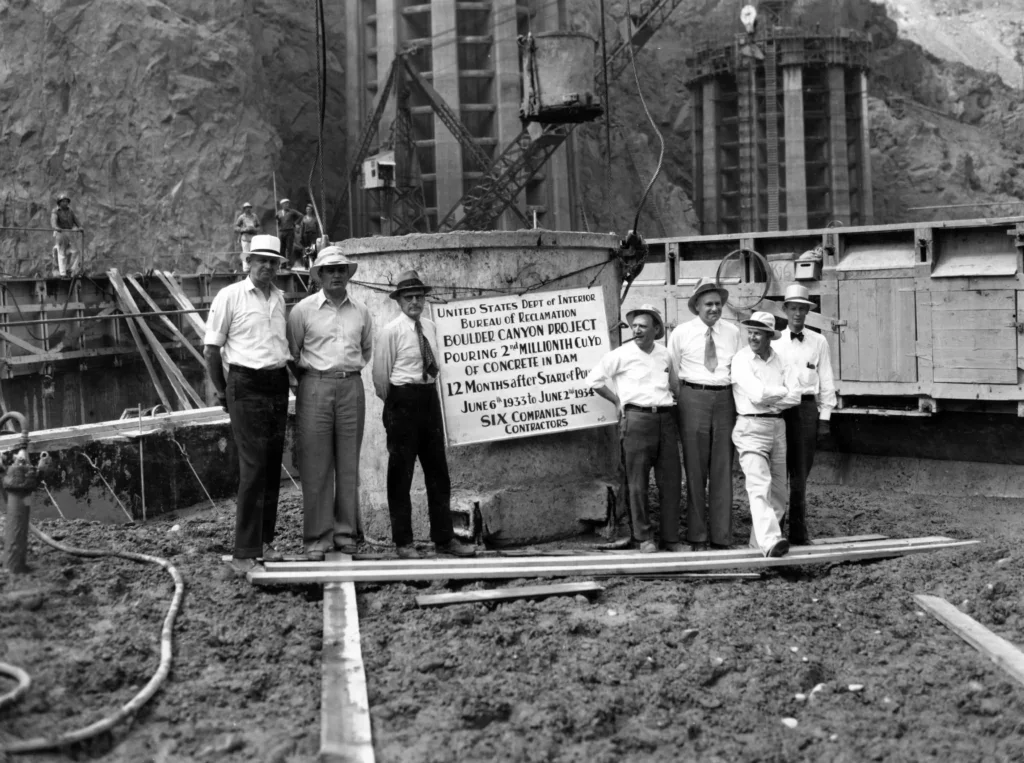
Bechtel Workers at The Hoover Dam. Source: Bechtel Corporation.
Bechtel's response to complexity was not to reduce it. It was to develop the organizational capability to manage it, moving its Platform Coordination capability from Stage 2 toward Stage 5, without the Product discipline at Stage 3, which manufacturing organizations build first. The company invested in systems engineering, cost-plus and design-build contracting structures, regulatory navigation, and the management of government clients whose procurement processes were fragmented in ways that made conventional contracting unworkable.
The result was a company that could take on the Big Dig—the $14.6 billion reconstruction of Boston's Central Artery, the most complex urban infrastructure project in American history. Bechtel would accept the enormous scope creep, cost overrun and schedule delay, and deliver it.
The Bridge
Bechtel's Platform Coordination capability is, in the right context, genuinely irreplaceable—and recognizing this is as important as recognizing its limits.
There will always be infrastructure that is too complex, too site-specific, and too programmatically varied to industrialize in the factory sense. Hospitals are built in dense urban environments. Transit systems threaded through existing infrastructure. Industrial facilities with unique process requirements.
For these projects, the Stage 5 Platform Coordination capability is the answer. The ability to hold a complex system together across fragmented contractual boundaries and define interfaces, manage integration points, and coordinate hundreds of independent actors toward a single outcome is precisely what these projects require.
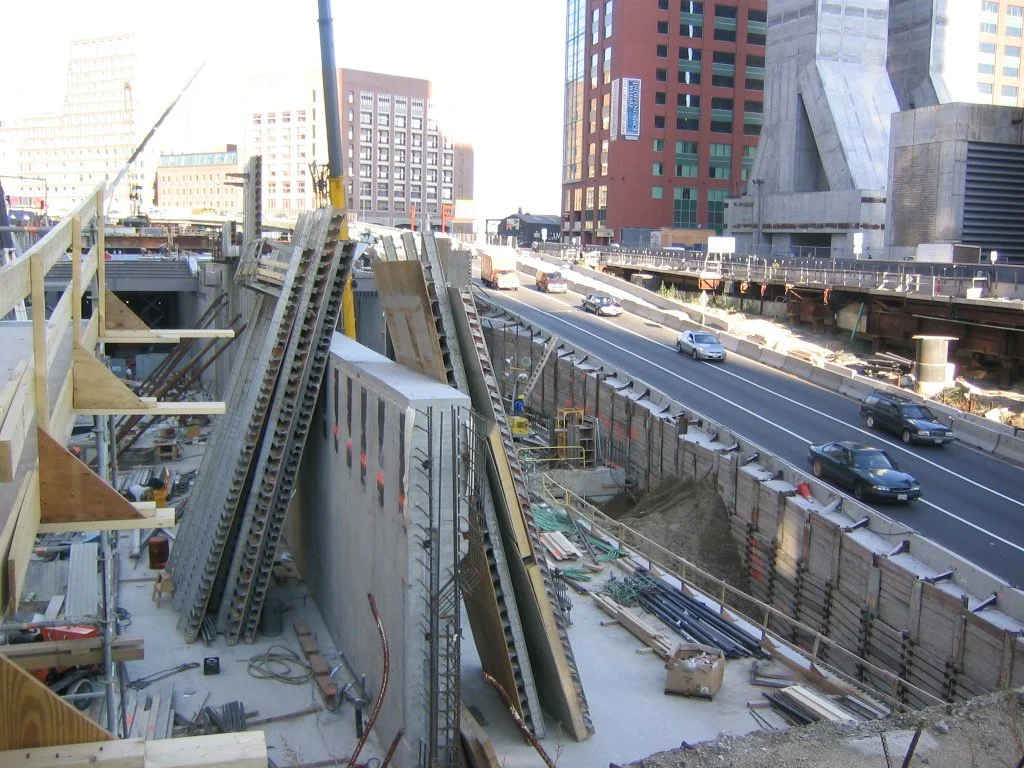
Big Dig in Boston, 2003. Courtesy of Societe Canadienne de Genie Civil Chapitre Etudiant de l'Ecole de Technologie Superiure.
"Integration capability is the bridge from fragmented project delivery to coordinated system delivery. It becomes a trap when the business model depends on the complexity it was built to manage."
The core practice of systems engineering applies to any organization managing complex, interdependent scopes: decompose the system into subsystems, explicitly define interfaces, and manage integration points before they become field problems. Most construction organizations manage interfaces reactively. The Bechtel approach defines them in advance, assigns clear ownership, and builds the coordination infrastructure that makes field resolution unnecessary. This is Stage 4 Platform Coordination behavior—and it is available to any GC, construction manager, or program manager willing to invest in the capability.
For genuinely complex, one-of-a-kind projects, high Platform Coordination capability is the bridge from fragmented project delivery to coordinated system delivery. It is also, as the Supply Overview argued, a precondition for building the factory-compatible interface standards that Stage 3 Product discipline requires. An organization that cannot coordinate complex interdependent scopes cannot define the interfaces that make a standard product viable across a fragmented supply chain.
The Trap
The trap opens when Platform Coordination capability is applied to projects that could be simpler but aren't because the industry's default procurement and design practices have made them unnecessarily complex.
The Big Dig cost $14.6 billion, compared with an original estimate of $2.6 billion. The schedule ran nine years over. Some of the perceived overrun was due to meaningful expansions of the project to achieve a more complete solution upon completion of construction. Green spaces, parks, additional utilities, and community engagement points were all added after the project began. Some of that overrun was due to genuine engineering complexity, as the project was built beneath a functioning highway in a dense urban environment with no precedent for the specific combination of tunneling, demolition, and traffic management it required. Some of it was unnecessary complexity resulting from fragmented procurement, adversarial contracting, political interference, and design changes driven by stakeholders not party to the original program definition. Bechtel managed both, and an earlier manufacturing mindset might have eliminated significant portions of the second kind.
This is the trap in its most precise form. Platform Coordination capability is a response to complexity. It is not a cure for it. An organization that develops deep expertise in managing fragmented supply chains has a structural interest—financial, reputational, and organizational—in their continued existence.
The Bechtel model, at its logical conclusion, optimizes for managing a broken, unoptimized system rather than designing a better one.
The second mechanism operates more gradually. When an organization develops Stage 5 Platform Coordination as its primary differentiator, its business model depends on being called in to work on complex projects. The incentive to reduce complexity—to fix product specifications, to standardize interfaces, to design procurement structures that enable supply chains to invest in learning—runs directly counter to that business model. This is not a moral failure. It is a structural one. And it means that the organizations best positioned to bridge the gap between project delivery and industrialized production are also the organizations with the strongest incentives not to close it.
The Model
Bechtel's case makes three arguments for the Supply audience.
High Platform Coordination capability without Product discipline produces efficient fragmentation rather than industrialization.
Bechtel is a Stage 5 organization in Platform Coordination terms. What it demonstrates is that this capability, built without the Product discipline that precedes it in manufacturing contexts, produces sophisticated management of complexity rather than its elimination. The lesson is to build Platform capability in service of a manufacturing trajectory, toward Product discipline and Process flow, rather than as a substitute for that trajectory.
The bridge is most valuable when it is temporary.
The best use of Bechtel-style Platform Coordination in an industrializing supply chain is to manage the transition period to hold a complex system together. At the same time, the product standards, interface definitions, and supplier development work that will eventually make the coordination unnecessary are underway. A GC, using its program management capabilities to define interfaces, develop specifications, and build supplier relationships toward a platform-based delivery model, is using integration as a bridge. A GC using it to justify continued project-by-project delivery without investing in the platform is using it as a trap.
Managing complexity and eliminating complexity are not the same investment.
In the short term, it is easier to develop the Platform Coordination capability to manage complexity than to develop the Product and Process capability to eliminate it. The first path produces project management expertise and near-term revenue. The second produces industrialization. They are not the same thing, and investing in one does not lead to the other.
The Limits
Bechtel's Platform Coordination capability was built around large, complex, one-of-a-kind infrastructure projects. The capability does not transfer automatically to the high-volume, lower-complexity, specification-driven work that industrialized construction requires. A Bechtel-trained program manager deployed to manage the delivery of a 300-unit modular apartment complex is bringing Stage 5 Platform tools to a problem that requires Stage 3 and Stage 4 capability—product lock and process flow—that Bechtel's model was never designed to develop.
The revenue model of high Platform Coordination capability creates structural resistance to industrialization even when the organization is intellectually committed to it. Simplifying the product, standardizing the interfaces, and developing the supply chain to the point where coordination overhead is unnecessary would reduce the addressable market for the core capability. Overcoming this requires either a separate business unit with different economics or a deliberate transition strategy that accepts near-term revenue compression in exchange for a long-term platform position.
Where to Start
The Bechtel argument, read as both bridge and trap, reduces to one question: Are you building Platform Coordination capability in service of a manufacturing transition, or as a substitute for one?
A GC who responds to coordination failures at the subcontractor interface by hiring better coordinators is investing in the bridge—and that may be exactly right for the current project. A GC who responds to the same failures by redesigning the interface—standardizing the connection detail, prefabricating the assembly that spans the interface, restructuring the contract to assign clear ownership—is building toward Stage 3 Product discipline and the manufacturing transition. Both responses solve the immediate problem. Only the second reduces the problem over time.
An architect whose standard of practice treats coordination complexity as an inevitable feature of construction—and designs accordingly, with contingency and flexibility built in to account for expected coordination failures—is encoding Bechtel's Stage 1 Product assumption into the project before construction begins. The manufacturing mindset at the design stage asks: which interfaces in this design will fail in the field, and how can the design eliminate them rather than plan around them?