Levitt: The Factory That Never Left the Site
William Levitt did not build a factory. He turned a construction site into one.
The distinction matters because Levitt's innovation is the most directly applicable in the Supply series to the current state of American construction, where the dominant delivery model remains site-based, where moving work off-site faces regulatory, financing, and cultural resistance, and where the manufacturing mindset has to operate within the constraints of the field rather than in the controlled environment of a production facility.
Levitt showed that those constraints are not insurmountable. With the right product, the right process, and the right demand signal, a construction site can achieve a level of throughput close to that of a factory. Not factory quality in every dimension. Not the factory cost in every category. But factory logic—specialized labor, sequential flow, task repetition, compounding efficiency—applied on the ground, at scale, under the open sky.
The Intervention
The context is postwar Long Island, 1947. The FHA and VA mortgage programs had created a buyer class of unprecedented homogeneity and scale—millions of veterans, standardized income profiles, standardized financing, standardized expectations for what a home should be. The demand signal was the most legible in American residential history. Levitt's contribution was the supply-side response.
The product was fixed first. Levitt designed a small, standardized Cape Cod house—800 square feet, four rooms, fixed layout, no customization. The design was not driven by architectural ambition. It was driven by the FHA appraisal standard, which defined what a conforming house looked like and what it would be worth. Levitt built to the financing instrument, not to the market's aspirations.
With the product fixed, Levitt redesigned the production process from first principles. He identified 27 distinct construction operations and assigned each to a separate specialized crew. The framing crew framed. The roofing crew roofed. The plumbing crew plumbed. No crew did more than one operation. No operation was done by more than one crew type. Each crew moved from lot to lot across the subdivision in sequence, performing its single operation and moving on.
The result was a moving assembly line without the line. The houses stayed still. The crews moved. At peak production, Levitt's operation was completing 30 homes per day across the Levittown, New York subdivision—one house every 16 minutes of the working day. Construction time per house had fallen to 15 days from groundbreaking to completion.
Levitt also vertically integrated his supply chain to a degree unusual in residential construction. He owned the lumber mill that supplied his framing materials. He owned the company that manufactured the appliances installed in every kitchen. He bought nails by the trainload. These were not quality decisions or brand decisions—they were production decisions. Every external dependency was a source of variability that could disrupt the flow of specialized crews moving through a planned sequence.
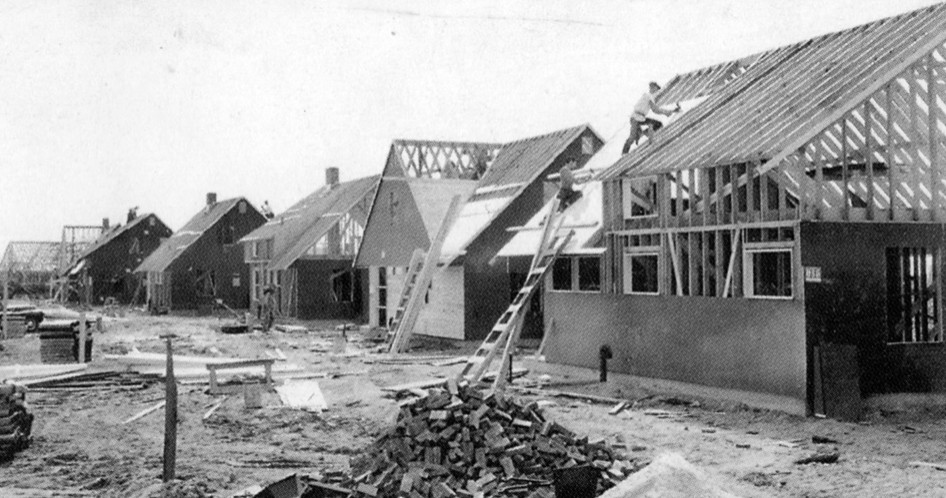
Levitt homes being mass-produced, 1947, photo from the Newsday archive, published in Hometown Long Island, a Newsday Book, 1999
At completion, Levittown, New York, comprised 17,447 houses, housing approximately 75,000 people. Levitt built more housing units in less time than any private developer had achieved in American history. The price per house was $7,990, which was affordable to veterans with VA loans, but out of reach before the financing instrument existed.
The Model
Levitt's achievement is a site-system story. He did not move the work to a factory. He applied factory logic to the site—and the factory logic that matters most is not prefabrication. It is specialization and flow.
Task specialization beats generalist flexibility when the product is stable. Levitt's 27-crew model worked because the house didn't change. Every framing crew on every lot was framing the same house. Every roofing crew was installing the same roof. The learning curve ran not just within a single project but across thousands of identical projects in sequence. By the time Levitt's crews had built their hundredth house, they were significantly faster and more accurate than they had been on the first. By the thousandth, the gap was enormous.
Flow at the site level requires the same discipline as flow at the factory level. Levitt's site operations failed whenever a crew arrived at a lot that wasn't ready—for example, when the preceding operation was incomplete, materials hadn't been delivered, or a variance had been introduced that the specialized crew wasn't trained to handle. The production discipline that made the system fast was fragile: any break in the sequence cascaded forward, disrupting every subsequent crew. This is the construction version of the factory bottleneck—and it requires the same management response: identify the constraint, eliminate it, protect the flow.
Vertical integration is optional but powerful. Levitt's ownership of the lumber mill and appliance company was extreme—most builders cannot or should not replicate it. But the underlying logic transfers: reduce the number of external dependencies that can introduce variability into a planned production sequence. For a GC running a high-repetition program, this might mean a preferred supplier agreement with a single framing package vendor, a standing order with a mechanical prefabricator, or a direct relationship with a window manufacturer. Not ownership—but the supply chain equivalent of Levitt's lumber mill: a relationship stable enough to plan around.
"Levitt built 30 homes per day at peak. The crews moved around the site as if on an assembly line without the line."
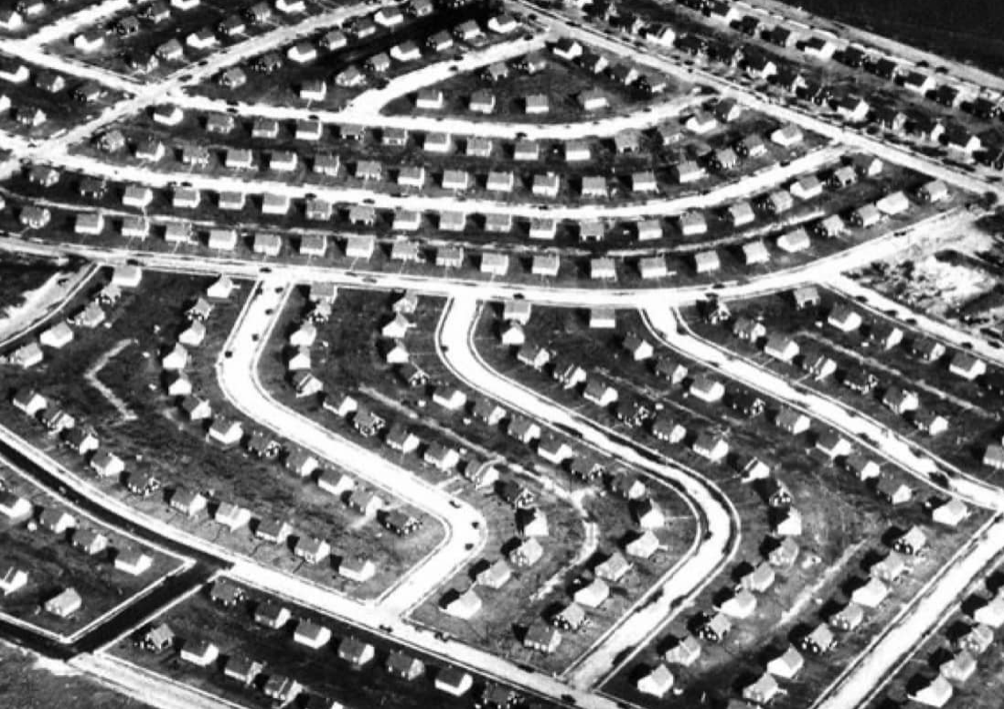
Levitt Subdivision aerial view
The Limits
Levitt's model worked for a specific product under specific market conditions. The standardized Cape Cod house met the FHA appraisal standard and the VA buyer's expectations because the financing instrument had shaped those expectations. The buyer didn't want more than Levitt was offering—or couldn't afford to want it. When buyer expectations shifted in the 1950s and 1960s toward larger homes, more variety, and suburban differentiation, Levitt's rigid production model struggled to adapt.
The racial exclusion embedded in Levittown is not a footnote. Levitt's leases explicitly prohibited occupancy by non-white residents. The FHA appraisal standards that shaped Levitt's product design also shaped the geographic distribution of mortgage lending, systematically excluding Black Americans from the wealth-building that postwar homeownership delivered. The production efficiency and structural discrimination were inseparable—both were consequences of the same financing instrument. Any operator drawing production lessons from Levitt is obligated to carry that history forward.
Levitt also did not solve the system problem above the site level. His vertical integration addressed supply chain variability within his own organization, but the broader ecosystem—permitting, financing, community governance—remained fragmented. When Levitt attempted to expand beyond Long Island to Pennsylvania and New Jersey, the production logic transferred. Still, the efficiency gains eroded as the demand signal became less homogeneous and site logistics became more complex.
Where to Start
The Levitt argument reduces to one question: Have you organized your site workforce around task specialization and flow, or around generalist flexibility?
A GC running a multi-unit residential program who uses multi-trade crews—teams that frame, then help with mechanical rough-in, then assist with finishes—is organizing for flexibility. Levitt's model is available: decompose the scope into its constituent operations, assign each to a dedicated crew, and sequence those crews across units rather than through a single unit. The efficiency gain comes not from any individual crew being faster, but from eliminating the setup, teardown, and context switching that consume time when a generalist crew does everything.
An architect designing a multi-unit residential project who specifies different window sizes, different structural bays, or different floor plan configurations across units within the same building is making Levitt's inverse decision—designing for variety rather than flow. The question to ask at the design stage is: which elements of this program genuinely require variation, and which are varied by habit or client preference? Every genuinely necessary variation is a cost. Every unnecessary variation is a choice.
A supply chain innovator developing a panelized or prefabricated system for the residential market faces the same constraint Levitt did: the system produces flow only if the product is stable enough to plan the production sequence around. The first conversation with any developer client should not be about the product's features. It should be about the developer's pipeline: how many units, how similar, over what time period. Levitt's production logic doesn't work for one project. It works for a program.