The Cheat Code for Scalable Geothermal

InnoviaGEO didn't build a better drill. They built a system that unlocks geothermal for the 94% of buildings the industry left behind.
Most climate startups pitch breakthroughs. New materials. New algorithms. Higher performance curves. Andrew Lee, co-founder and president of InnoviaGEO, took a different path. While the geothermal industry spent decades optimizing around depth — because that's where the rigs went and the conventions pointed — InnoviaGEO optimized around a simpler question: what resource are we actually trying to reach?
The answer changed everything.
Conventional geothermal systems drill 600 to 850 feet into the ground chasing stable temperatures. It works. But it's expensive, it carries real geological risk, and it depends on a small and overcommitted pool of specialized drillers. The result is that geothermal heating and cooling has remained viable only for high-rises and large institutional buildings — the 6% of the building stock with enough square footage to absorb the cost. The other 94%, low and mid-rise commercial and institutional buildings representing the majority of built space across North America, has been left on the sideline.
InnoviaGEO is building the on-ramp.
The Assumption Audit & A Developer’s Perspective
Andrew Lee isn't a materials scientist. He came up through energy development — wind in Ontario in the early 2000s, hydro projects in Peru and Chile, transmission infrastructure linking power grids across South America. He understands permitting, financing, policy, and what makes infrastructure bankable. When he turned his attention to geothermal, he brought a developer's instinct: before you build anything, question whether you're building the right thing.
The industry's foundational assumption — that effective geothermal requires deep drilling — turns out to be an inheritance from geothermal power generation, which genuinely does require extreme subsurface temperatures. Geothermal heat pump systems are a different application entirely. They don't need hot rock. They need stable ground temperature. And stable ground temperature, it turns out, exists nearly everywhere at around 30 feet deep.
"What's the resource we're actually trying to access?" Lee said. "It's not liquid hot magma. It's simply the stable temperature of the ground. And that exists just 30 feet below us, everywhere."
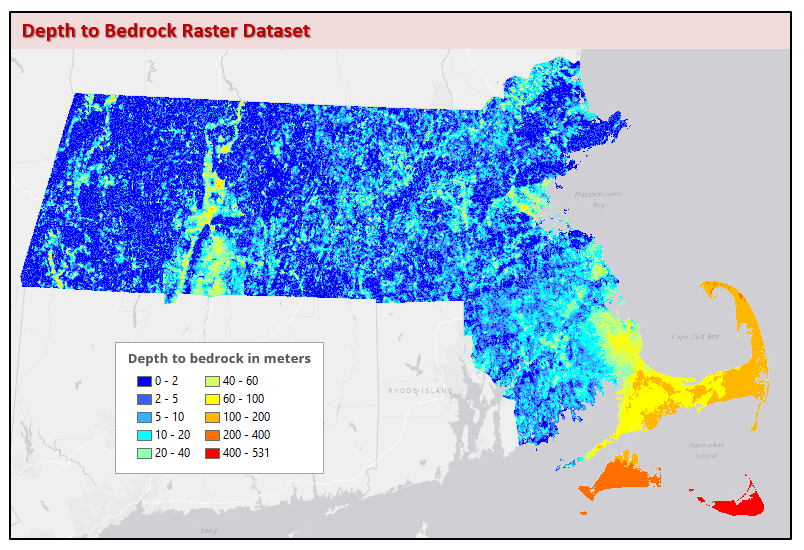
Depth to bedrock across Massachusetts (GIS Data)
Measured ground temperature data from InnoviaGEO's Buffalo pilot makes the case more specifically: the ground at 15 to 30 feet is actually warmer through winter than at 40 feet and below. Summer heat migrates downward slowly through soil — the temperature at 10 feet peaked in mid-October, 15 feet in mid-November, 20 feet at the end of December. The shallow ground, seasonally, is the better thermal resource. Not worse. Better.
In Massachusetts and across much of the Northeast, bedrock appears within 10 to 40 feet of the surface. Deep drilling in these geologies quickly becomes expensive and risky — you hit the constructible layer fast and then encounter hard rock. InnoviaGEO's systems live entirely in the overburden, the zone where foundation contractors and utility drillers already work every day.
Product Design Over Technology Claims
InnoviaGEO didn't start in a lab. It started with a remediation.
Andrew and his co-founder Jim were brought into a 55-unit townhouse redevelopment in downtown Toronto that had gone through bankruptcy with a geothermal system half-installed. The first advice the new developers received: scrap it, put in a gas furnace, be done with it. Lee and his partner rebuilt it instead. That project exposed the real constraint in geothermal — not the physics, not the thermodynamics, but the installation economics and execution risk that made conventional systems impractical for exactly the building types most in need of decarbonization.
From that starting point, InnoviaGEO iterated in the field. Foundation-integrated GEO piles for new construction. Standalone vertical GEO columns that can be retrofitted into existing buildings. Horizontal systems using directional drilling methods already standard in the underground utilities industry. Three system types. Each one designed around a different site constraint rather than a single idealized installation scenario.
The resulting claims are deliberately unflashy. Look at what InnoviaGEO leads with:
2–5x faster to install
25–50% cheaper
Less geological risk
Scalable through existing contractor networks
Not "breakthrough thermodynamics." Not "superior efficiency curves." These are deployment claims — the language of someone who has thought carefully about what actually prevents a technology from scaling, and designed backward from those constraints. The ICP is explicit and narrow: low and mid-rise commercial and institutional buildings across Canada and the Northeast US. Buildings with one owner, one decision-maker, and enough square footage to make the economics work without needing to be a skyscraper.
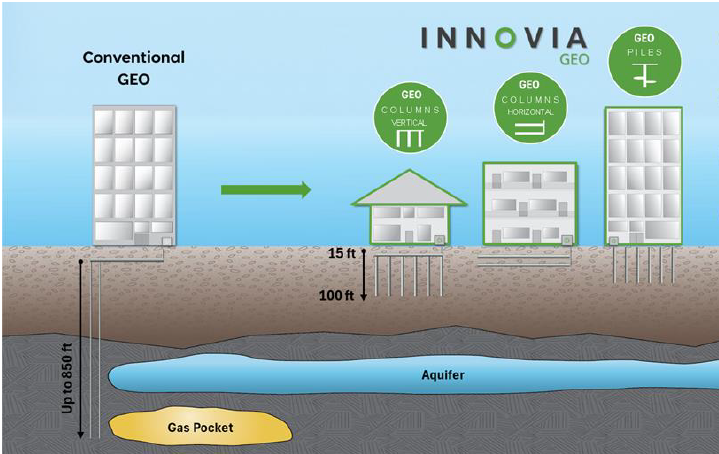
The three InnoviaGEO system types — GEO Piles, Vertical GEO Columns, Horizontal GEO Columns
The Supply Chain Is the Moat
Most climate hardware startups respond to bottlenecks by going full-stack: design the system, buy the rigs, hire the crews, control every step. It gives you quality control. It also makes you a construction company, limits your geographic reach to wherever your equipment and crews can operate, and puts a hard ceiling on how fast you can grow.
Andrew did the opposite.
The geothermal driller shortage isn't just a cost problem — it's an industry-wide scaling ceiling. There are a handful of certified geothermal drillers in any given market. They are busy, expensive, and the single-point bottleneck through which every conventional geothermal project must pass. InnoviaGEO's systems don't pass through that bottleneck.
"We're not limited by the three geothermal drillers in the Ontario market or the five that service New York State," Lee said. "There's just so few of them. You can't scale that way."
Instead, InnoviaGEO's vertical columns are installed by foundation contractors — already on site, already credentialed, already drilling soldier piles and caissons for the same buildings InnoviaGEO's customers own. The horizontal systems use directional drilling methods used daily to run gas lines and fiber beneath streets. These are not scarce resources. There are thousands of these contractors across the Northeast alone.
The IP sits in the engineering layer — the design and modeling tools that translate a specific building's heating and cooling load and a specific site's soil profile into a precisely specified system. That took years of work with academic research partners, physics-based modeling, and real-world pilot validation to build. It is genuinely hard to replicate. The installation itself can be executed by contractors who don't need to understand the underlying heat transfer equations.
It's the structural logic of distributed solar: the developer owns the engineering, the project economics, and eventually the long-term asset. The physical installation is subcontracted to a wide and competitive pool of existing trades. You don't become a driller any more than a solar developer becomes a panel manufacturer.
The Funder No One Else Thought to Ask
Here is the insight that doesn't show up in most geothermal pitches, and the one that most directly explains how InnoviaGEO got to three completed pilots and two more underway on a single $200,000 angel investment and over $3 million in non-dilutive funding.
The building sector will not fund pilots. Real estate developers and owners are not in the R&D business. HVAC is 5–10% of a project's total cost. They will express genuine interest and then tell you to come back when you have five buildings done and can tell them precisely what their capex and savings will be. Which is exactly what you need the pilot funding to produce.
So Lee looked sideways — at the customers who could pay for this phase, even if they weren't the ultimate customers for the product.
Power utilities are quietly anxious about what widespread air-source heat pump adoption does to peak grid demand. They have innovation funds specifically designed to test technologies that might reduce that stress. Gas utilities, facing regulatory pressure in markets like New York, are building unregulated subsidiaries and exploring geothermal as a transition hedge. Neither thinks like a building owner. Both have money to spend on experiments that could matter to their business model.
"The building sector isn't going to fund the commercialization of the technology," Lee said. "They don't fund R&D. But utilities do."
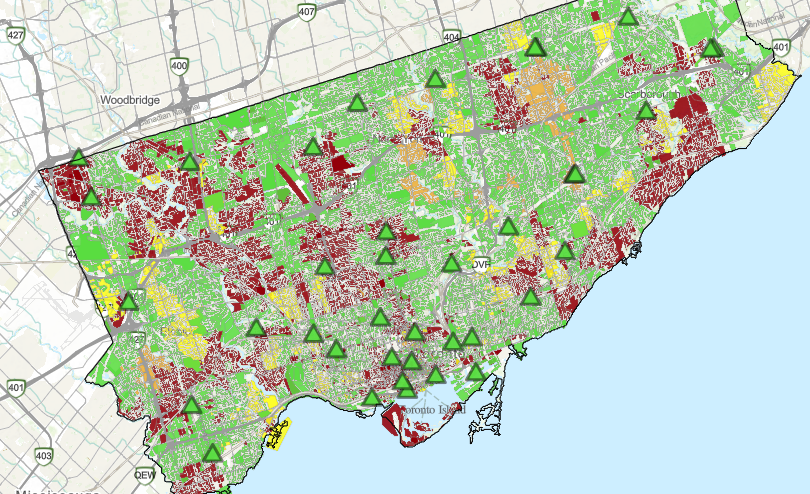
Toronto, Ontario grid capacity map. Constrained grids (red) highlight a unique opportunity for geothermal to provide supplemental grid resilience. Source: Toronto Hydro
InnoviaGEO's first pilot came through Ontario's grid innovation fund — an ISO that sees perhaps one geothermal proposal every five years and found the application genuinely distinctive. The second came through a gas utility that had run into aquifer restrictions on its own conventional geothermal project and remembered a conversation with a company that drilled shallow. NYSERDA followed. National Grid's Future of Heat team is now co-funding work in Buffalo.
Each partner served a dual purpose: funding the current pilot and providing the institutional credibility to unlock the next conversation. Ontario ISO → gas utility → NYSERDA → National Grid. The sequence wasn't architected in advance. But in retrospect it's the same playbook as any infrastructure developer: find who has risk-aligned capital at each stage, sequence your proof points to match their needs, and let the validation stack compound.
From Pilot to Platform
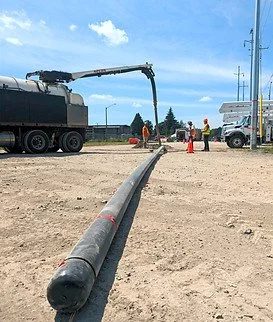
Horizontal GEOColumn Pilot (Newmarket, ON)
The next projects in New York State will demonstrate full-building heating and cooling in a building over 25,000 square feet — the first time InnoviaGEO's system will carry 100% of a building's thermal load. That is the proof point needed to approach the commercial real estate sector directly. The design and screening tool under development will reduce system specification from weeks to hours. When it's ready, the go-to-market problem shifts from "can we prove this works" to "how do we reach building owners at scale." That's a marketing and distribution challenge. Compared to what came before, it's a welcome one.
The longer arc is a distributed geothermal utility model. InnoviaGEO developing, designing, and operating systems under a GEO-as-a-service structure — building owners pay for thermal output rather than capital equipment, InnoviaGEO owns the long-term asset and its economics. The 30% federal Investment Tax Credit for commercial geothermal remains available through 2033. The policy and financial infrastructure for that model is in place. The missing piece has always been an installation approach that could actually scale.
Lee's developer background runs through all of it. Cautious capital deployment. Regional focus — Western Ontario and New York State, where policy is supportive and the contractor ecosystem is maturing — rather than premature geographic expansion. A preference for doing the minimally necessary thing at each stage until something is bankable. He watched startups fail earlier in his career when they overextended and lost direct oversight before the product was proven. InnoviaGEO was built deliberately to not do that.
"It's the development approach," he said. "You're cautious. You try not to spend anything. You do what's minimally needed until you've got a project you can finance — and then you work like hell to get it to the stage where you can build on it."
Climate technology doesn't always need to go deeper. Sometimes it needs to stay in the constructible layer, ask the obvious question the industry forgot to ask, and build a system smart enough that the market already knows how to install it.
Geothermal energy is closer than you think. Andrew Lee has three pilots, two utilities, and a ground temperature dataset from Buffalo to prove it.
InnoviaGEO was just accepted into Scale For ClimateTech Cohort 7 and is preparing a pre-seed round. If you're a building owner exploring electrification, a utility exploring geothermal partnerships, or an investor tracking the distributed thermal infrastructure space, Andrew Lee is worth a conversation. Please reach out for an introduction: ryan@intentionalgrowth.partners