Military Housing: Scale, Commitment, and the Conditions for Industrialization
The US Military is the largest real estate operator in the United States. It manages approximately 200,000 family housing units across more than 70 installations. Its annual Military Construction budget typically exceeds $2 billion for housing alone. Its resident population of active duty service members and their families is among the most consistent tenant bases any landlord could ask for: predictable income, predictable household sizes, predictable tenure, predictable maintenance requirements.
If any buyer in America could generate the standardized, repeatable, high-volume demand signal that would industrialize the housing supply chain, it is the US Military.
The military has volume, need, and budget. It has tenant predictability, institutional authority, and a resident population whose requirements are more consistent than those of any private developer. What it lacks is the procurement architecture that converts those ingredients into a supply chain signal. Every component of the demand signal is present. The signal itself is absent.
Historical Proof: The Cycle of Industrial Success
The American military has demonstrated industrial-scale housing production three times, and each success stemmed from a shared principle: combining speed and volume with absolute control through standardization.
This intervention occurred during the World War II Cantonments of 1940–41, when the War Department faced a staggering mobilization crisis. As the Army expanded from a small peacetime force toward a goal of over three million troops by January 1942, the need for barracks, mess halls, and training facilities became an existential problem of throughput. The solution was not architectural innovation, but rather the Quartermaster Corps, and later the Corps of Engineers, developing and repeating standardized plans. Under unforgiving schedules requiring installations in as little as one week, custom projects were eliminated. The system worked because the buyer exercised authority to keep plans fixed, leaving no room for site-by-site variation.
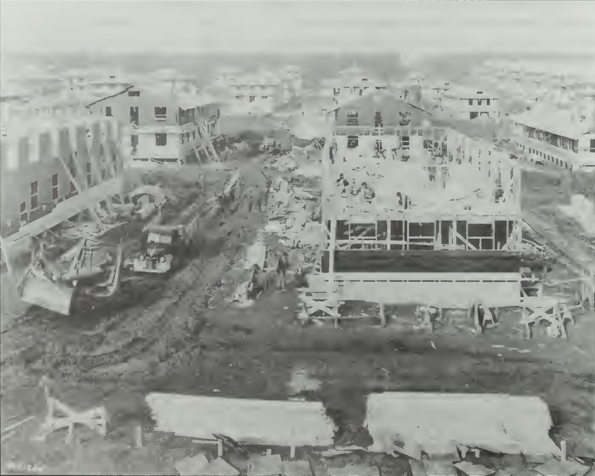
700 Series Barracks in construction. Source: World War II and the U.S. Army Mobilization Program: A History of 700 and 800 Series Cantonment Construction
Rigid procurement discipline evolved after the war through Capehart Housing, established by the Capehart Act of 1955. This era paired private development capacity with federal demand by using FHA-backed financing and service members' housing allowances to retire mortgages on projects that, upon completion, came under military control.
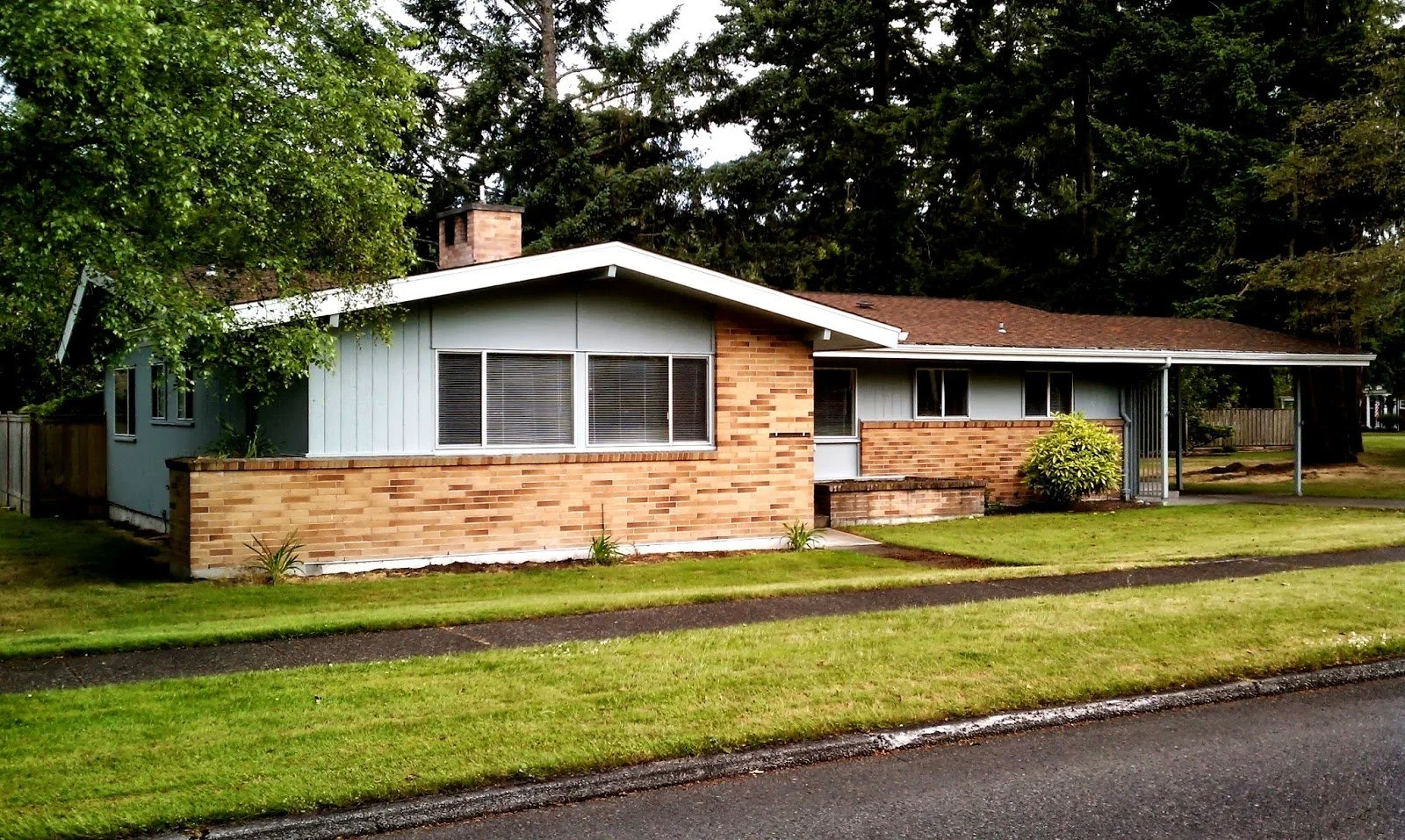
A restored Capeheart-era ranch in Fort Lewis, WA. Source: Modernista
It was a structural masterstroke that gave builders a guaranteed market and lenders federal support, delivering nearly 250,000 units of various architectural styles. By linking long-term commitment to a strict design standard, the military successfully converted private development into a standardized housing engine.
This same drive for consistency reappeared in the mid-2000s with the MILCON Transformation. Targeting a 15 percent reduction in planning and design costs and 30 percent faster delivery times, the Army and USACE leveraged Centers of Standardization and Building Information Modeling (BIM) supported design reuse.
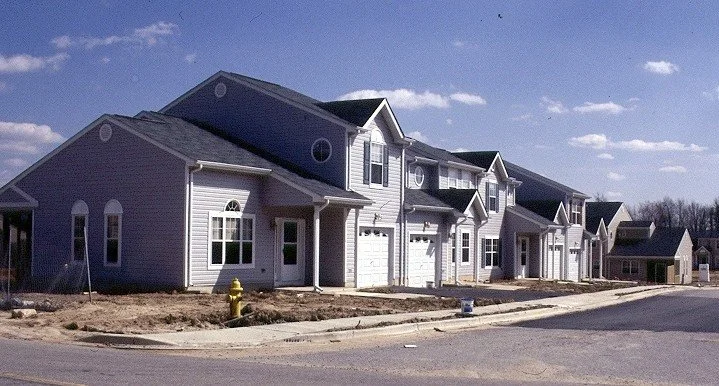
Fort George G. Meade Homes built in 2008 under MILCON Transformation. Communities also included daycare centers and community amenities. Source: MILCON Soldiers Magazine, 2008.
Across these three distinct periods, one principle remains clear: When the military paired credible commitment with standard design and procurement discipline, a learning curve appeared and production industrialized; when these conditions eroded, the system inevitably reverted to inefficient, project-by-project construction.
The Model
A federal housing budget, fragmented through annual appropriations, functions as a collection of small markets regardless of its total size. What a supply chain responds to is a credible, forward-looking commitment to purchase a specific product at a specific scale for a defined period.
Specification and commitment are one decision, not two. Capehart's success and privatization failure are the same experiment run with and without a design standard. Long-term commitment plus specification produced industrialization. Long-term commitment without specification produced extraction. Any long-term housing program without an enforceable design and maintenance standard is structurally vulnerable to privatization failure.
Geographic concentration enables learning. DoD's 200,000 units across 70 installations are less of a demand signal than a smaller, more concentrated program would be. A supply chain builds efficiency by producing the same product repeatedly for the same buyer.
Industrialization is a commitment to learning, not a procurement event. The supply chain that improves is the one that knows it will apply what it learns. The buyer creates that condition through commitment structure, not budget size.
Authorization is not commitment. Appropriation is not commitment. A guaranteed purchase order against a fixed spec is a commitment.
The Limits
The Military Housing is an extreme case. Congressional appropriation cycles, installation commander autonomy, and defense procurement politics create pressures for fragmentation that most public buyers don't face to the same intensity.
The privatization scandal has made the path back to Capehart politically difficult. The failed version has contaminated the working mechanism. Distinguishing between a long-term commitment with a spec and one without requires policy sophistication that public debate rarely achieves.
The WWII model worked because urgency was genuine, non-negotiable, and universally understood. Whether you can produce wartime procurement discipline without the forcing function of war is the question American infrastructure policy has been trying to answer for 80 years, without a clear answer.
Where to Start
The Military Housing argument reduces to one question: Is your commitment credible enough and stable enough that a supply chain has reason to invest in improving its ability to serve you?
A state housing agency that selects a standard unit type, issues a ten-year framework agreement to a small panel of regional builders, and commits minimum annual volume contingent on quality performance is doing Capehart. The framework agreement provides the commitment horizon. The standard unit type provides the specification. The minimum volume provides credibility. All three simultaneously.
A university system with a ten-year student housing program that defines a standard residential module—fixed room dimensions, fixed bathroom configuration, fixed structural system—and issues a long-term design-build agreement to a single regional delivery team creates commitment and specification simultaneously. The long-term agreement substitutes for annual appropriations that fragment public procurement.
A transit authority that identifies its most-repeated facility type, develops a reference design, and commits that design across the next ten procurements under a framework agreement generates the MILCON signal that produced documented 15–20 percent cost savings. A reference design with ten site-specific modifications is not a reference design; it is ten custom projects with a shared name.
Authorization indicates to a supplier that a project might proceed. A committed order tells them it will. Only the second justifies investment.