Slow the Fire, Play the Long Game

Rebuilding the Building Envelope Through Trust, Code, and Capital Discipline
Insulation is not a classic venture capital category. It is a sector dominated by 80-year-old product lines sold through established distribution and retail channels. Buried inside the building envelope, insulation is rarely seen and rarely discussed—despite quietly determining a building’s comfort, energy use, durability, and emissions.
Most of the materials insulating American buildings today were developed in the post-war era as a response to asbestos bans, consisting primarily of fiber and mineral based inputs or petroleum-based plastics. Plastic foam insulates the best, but if there’s a fire, it not only burns but spreads flames rapidly, and that’s a problem.
So when Liatris began developing a non-combustible board insulation that could serve as a drop-in alternative to foam, the real constraint wasn’t just the science. It was the market.
Understanding that constraint required experience in another capital-intensive industry. Co-Founder and CEO Frank Yang had lived through the realities of manufacturing at Stion, an early U.S. solar company where he helped raise more than $500 million and scale one of the country’s few domestic module factories.
One of this journey’s key lessons was what happens when ambition outruns ecosystem readiness. “My mentor at Harvard Business School, entrepreneurial marketing legend Joe Lassiter, told me when we signed the TSMC deal in 2010 that we should go fully to a fabless model and focus on higher returns in developing projects,” said Yang. “The exit and growth ambitions of venture investors often don’t align with the realities of an infrastructure or materials business, even when they are genuinely supportive.”
Although the capital light nature of the “fabless” model provided some inspiration for Yang’s founding of Liatris, he also recognized that insulation materials are not semiconductors. There are no existing foundries and it is a regionally distributed industry with low R&D investment governed by building codes and installer habits, leading to slow acceptance and relatively thin gross margins (30-35%) for even the most unique premium products. Rather than pursuing a broad mandate to “disrupt” insulation as so many new ventures aim to do, Frank and Liatris chose a narrower entry point driven by code, regulatory pressure and customer urgency: a fully non-combustible insulation board with easier handling and higher performance than mineral wool. Fire resistance wasn’t just a feature, it was strategic alignment.
Yang recalls an early VC asking whether Liatris was a product or a company. At the time, he said, the better answer was neither and both: the insulation industry had barely introduced one truly new product in fifty years, but Liatris believed it had identified a first product customers needed badly enough to create a foothold.
Trust Compounds Faster Than Capital
One of Yang’s favorite operating principles in business is a quote from another HBS mentor, recently retired entrepreneurial finance pioneer Bill Sahlman: “Startups don’t run out of cash. They run out of trust.”
“Many people ask me why I didn’t start Liatris earlier, and one of my answers is that without everything I did at Stion, we wouldn’t have any of the expertise or network needed to do this,” said Yang. “One of the great things about entrepreneurship in America is that I think investors can identify an individual’s commitment and drive even if the venture was not a massive exit; virtually every single investor I worked with at Stion provided formation advice, introductions or references that were key in getting us Liatris off the ground.”
Despite this, early sentiment toward Liatris was weak. Yang founded the company in March 2018, not long after the 2016 election dampened US enthusiasm in climate-related ventures. However it was an event overseas that set the company on the direction it’s in today.
When Yang founded Liatris, he spoke extensively with investors and practitioners across the construction ecosystem. But he also sought out people he trusted simply for perspective.
One of them was Nolan Browne, former head of the MIT Fraunhofer Lab and founder of the venture development firm ADL Ventures. The two had originally met in 2007 when Browne was at Evergreen Solar through an intro from Hemant Tanejaat General Catalyst (now their CEO), and had exchanged favors and information informally over the years on topics such as manufacturing site selection and supply procurement. “I had no specific agenda in reaching out to him other than knowing that Fraunhofer had done a lot of work in advanced construction, including insulation systems, and that he might know some corporates or investors in the space,” said Yang.
As it turned out, Browne was also a longtime board member of Sto Corporation, a global leader in exterior wall systems who were reacting to new code requirements for fire safety and potential foam insulation bans following the 2017 Grenfell Tower fire in London - a $1 billion in property damage and liability and causing 70 deaths.
One cardinal rule of ventures that Yang learned as a student of Lassiter was to align with strong domain expertise.
Browne’s team at ADL Ventures was assisting Sto on what was then a first-of-kind open innovation engagement called the Building Materials Challenge to identify and make future commercial commitments to novel technologies it could advance via being a first customer. The Building Materials Challenge took nearly a year—from initial submission to receiving a $180,000 R&D contract and conditional purchase order—but the market signal from a multi-billion-dollar incumbent selecting Liatris as the top technology out of 400 applicants was worth the wait.
In all, this capped off an 18-month period from the time Yang founded Liatris in March 2018 to the time the first dollar showed up in its bank account. Yang had another key advantage in his father and co-founder, Dr. Arthur Yang. Arthur was a longtime R&D leader in the insulation space, and some of Arthur’s former colleagues joined as advisors including the former CEO of Armacell and the former head of R&D at Dow.
“We knew that you could never commercialize this unless you somehow partnered with top incumbents,” said Yang. “The question given their long timelines and small R&D budgets was how we’d ever get to that point.”
From the time Liatris began seed round conversations in late 2019 to the time it closed the round in mid-2021, a global pandemic, a capital markets boom headlined by SPACs and other speculative deals, and another presidential election in the US had shifted headwinds back in favor of climate. However, Liatris never wavered from its strategy to keep its operations and cap table lean. The company raised a $1M seed round from a state venture capital fund and various industry angels. Early investors were intentionally small. No dominant board seat. No outsized amounts or valuations that required aggressive burn to justify the math. “Early in your career, it’s easy to get wrapped up in headlines and think that the amount of the raise is somehow a validation of your work,” said Yang. “Even in 2021, it was hard to see these massive numbers given to ventures that had none of the crucial alignment factors we did, but we knew we needed to stay the course as we needed more time than whatever temporary bubble existed to commercialize.”
Guided by Sahlman’s principle, Yang and his team treated each early validation as a step in building credibility.
An NSF Phase I SBIR grant which later led to a Phase II and two supplemental awards (TECP and Phase IIB) driven in large part by the strong market alignment with Sto and other industry players.
Two BENEFIT R&D awards from the Department of Energy’s Building Technologies Office, a program where the vast majority of awardees were in academia.
Various state and local funding sources, capped off by a successful ribbon-cutting with Maryland Governor Wes Moore in July 2025.
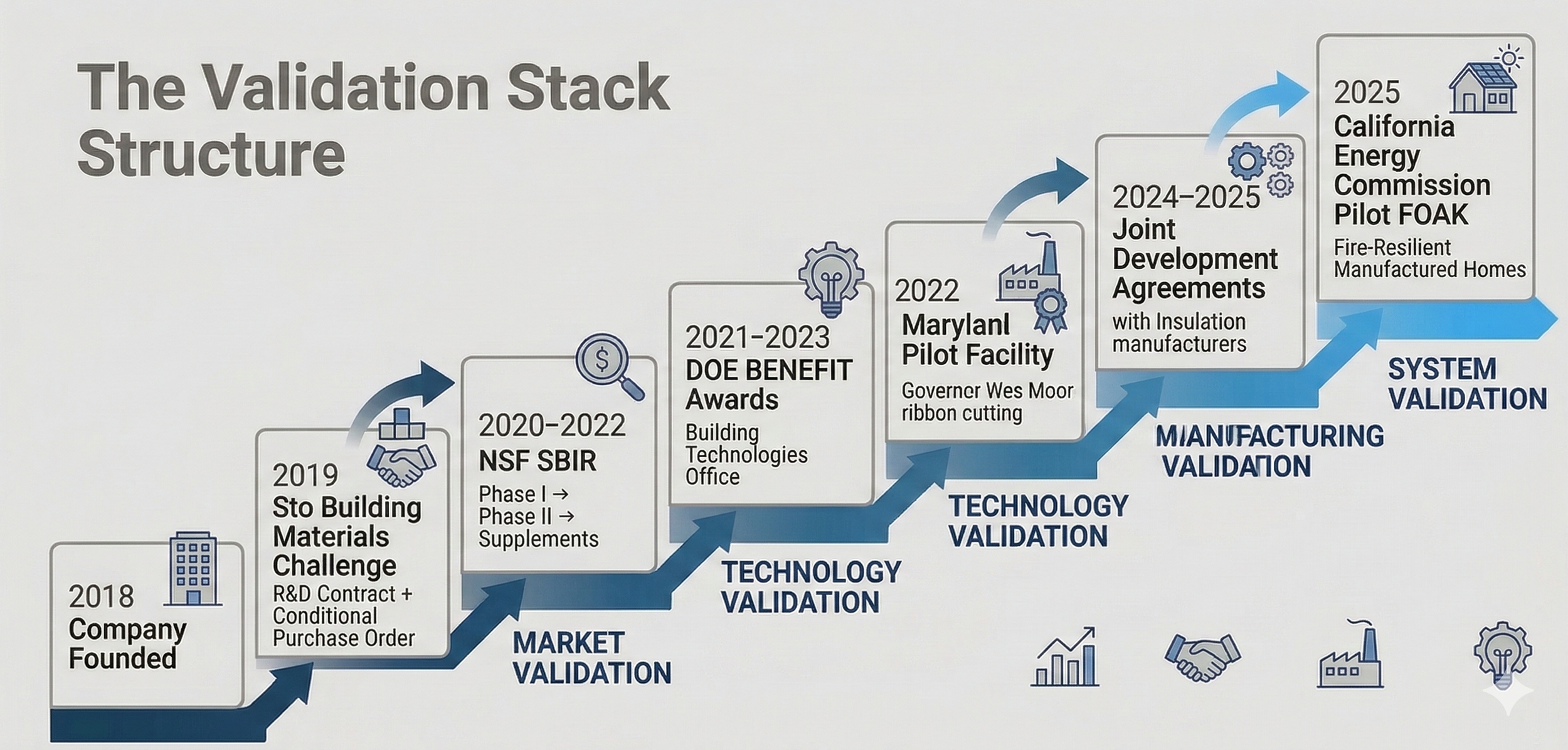
Liatris Development Timeline - Progressive Validation
Each step created external proof, and that credibility became one of the most important advantages Liatris had in its business. Particularly in the risk-averse worlds of government and building materials, word of mouth credibility travels faster than prototypes. “It was interesting during this resurgence in climate tech how many ventures got funded without ever talking to a real customer or end-user,” said Yang. “We not only had the customer demand signal, we had spent a ton of time cold calling architects, installers and others in the ecosystem, sometimes even dropping into their warehouses unannounced like I used to do when we sold our first panels in the solar business. Corporate and government program managers who give you funding value that grit and persistence, and from a practical standpoint they value risk mitigation that helps make this investment safer from a career perspective for them.”
Now that Liatris has demonstrated both non-combustible board prototypes and a low-cost R-10-per-inch aerogel composite, that sense of risk protection and security has evolved into attention. Manufacturers watch who else is willing to engage. Code officials observe testing milestones. Utilities track pilots. Insurance markets study failure modes.
That accumulation of trust mattered because Liatris was not pursuing a marginal performance gain. It was pursuing a problem most of the industry had learned to work around rather than solve.
Fire-Safe Is a Constraint Removal Strategy
Where most insulation innovation chases incremental R-value as a performance standard for differentiation, Liatris chose non-Where most insulation innovation chases incremental R-value as a performance standard for differentiation, Liatris chose non-combustibility. Frank describes mapping decades of insulation research and realizing the gap wasn’t obvious. It was avoided. “We literally mapped out a research curve of all the different technologies that had been tried… and it is something that nobody’s ever done before.”
At one point, a respected researcher told him directly that what they were attempting “[was] impossible. You can’t actually do what they’re proposing.” That reaction revealed the opportunity. Foam insulation is a lightweight, low-cost, excellent insulation, but combustible. Mineral wool is non-combustible but with lower performance at higher cost.
The decision to pursue that “impossible” fire-safe insulation wasn’t scientific bravado. It was systems math. A product that sits at the intersection of tightening building codes, insurance pressure in wildfire zones, energy-efficiency priorities and cost challenges would have the potential to change the industry.
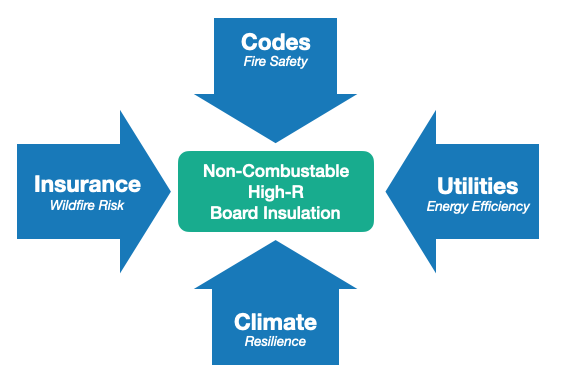
Basic cost and performance metrics were necessary to compete in the broad marketplace.
Fire safety and resilience offered unique metrics to carve out differentiated performance.
Unlike many government grants which simply lead to more grants, Liatris is constantly pushing the envelope of building performance for faster and higher ROI on its investment. It has engaged in two JDAs with major insulation manufacturers, again without relinquishing any of the valuable IP rights and potentially paving the way for licensing or joint ventures which allow for scale-up into mass production.
Just as importantly, Liatris was recently awarded a California Energy Commission pilot grant to deploy its insulation in First of a Kind (FOAK) fire-resilient manufactured homes across multiple climate zones.
In a state where wildfire losses are reshaping building codes and insurance markets, the project functions less as a demonstration and more as a signal — both for partners evaluating scale-up and for policymakers exploring similar pilots now emerging in Connecticut and Maryland.
Early installation work also reinforced something Yang emphasizes frequently:
Insulation innovation isn’t just a materials challenge, it’s a construction workflow challenge.
The lesson is quiet but powerful: in slow industries, speed comes from reducing perceived risk, not increasing noise. In many ways, Liatris is a materials breakthrough and a sequencing strategy: solve the constraint, earn trust, and scale through alignment.
Forward View: Building at the Speed of Risk
Construction markets move slowly, until risk accelerates change. Wildfire losses, insurance repricing, utility load growth, and code revisions are not hype cycles; they are structural pressures on the built environment.
Liatris is positioned where those pressures converge: the building envelope. Three years from now, its success will not be measured by valuation multiples. It will be measured by square footage installed through partners, targeted direct deployments, and whether insurers and utilities begin treating higher-performance insulation as risk mitigation rather than premium upgrade.
Industrializing infrastructure requires a certain temperament. Founders have to be comfortable with long cycles, slow validation, and incremental proof. They have to resist the temptation to oversell what they have not yet installed at scale. They have to design their capital structure to match the time horizon of the product.
Yang calls it “staying the course”. In an industry where products can sit inside a wall for a century, impatience is expensive.